







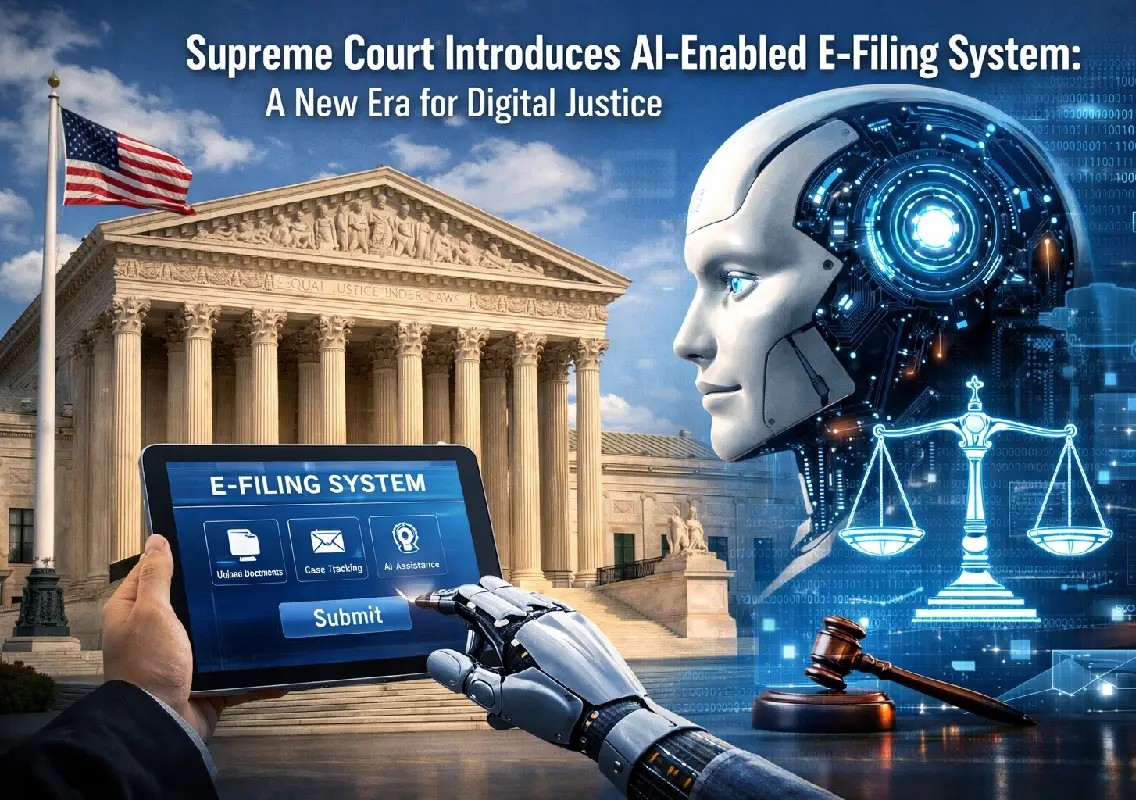


Supreme Court of India has announced two major digital initiatives aimed at modernising the country’s judicial system — ‘One Case, One Data’ (OCOD) and ‘Su-Sahayak’, an AI-powered chatbot integrated into the court’s website.
The initiatives were announced by Surya Kant as part of the judiciary’s continuing efforts to improve access to justice and strengthen digital court infrastructure.
Unified case tracking system introduced
The OCOD platform aims to create a unified digital identity for every case as it moves through various courts in India.
According to the Supreme Court, the system will help connect court records, appeals, litigant actions and judicial documents across different levels of the judiciary. It is also expected to reduce manual verification processes and improve coordination between High Courts, district courts and subordinate courts.
Legal experts say the initiative could help identify procedural bottlenecks, improve case management and strengthen data-driven decision-making within the judiciary.
AI chatbot to assist court users
The newly launched ‘Su-Sahayak’ chatbot has been integrated into the Supreme Court website to help users access case status, judgments, orders, cause lists, e-services and frequently asked questions more easily.
The judiciary has previously introduced AI-assisted tools such as SUVAS for judgment translation and SUPACE for analysing legal facts and precedents.
Concerns over digital divide remain
While the initiatives have been welcomed as progressive steps, concerns have also emerged regarding accessibility and digital inequality.
Legal observers noted that smaller lawyers and independent practitioners in district and taluka courts may struggle with the costs of scanners, cloud storage and updated digital systems required for seamless participation.
Experts have also warned about the risks of biased AI systems, data privacy concerns and misuse of centralised judicial records if adequate safeguards are not implemented.
Critics pointed out that the largely text-based Su-Sahayak platform may be difficult for people unfamiliar with typing or navigating digital interfaces