







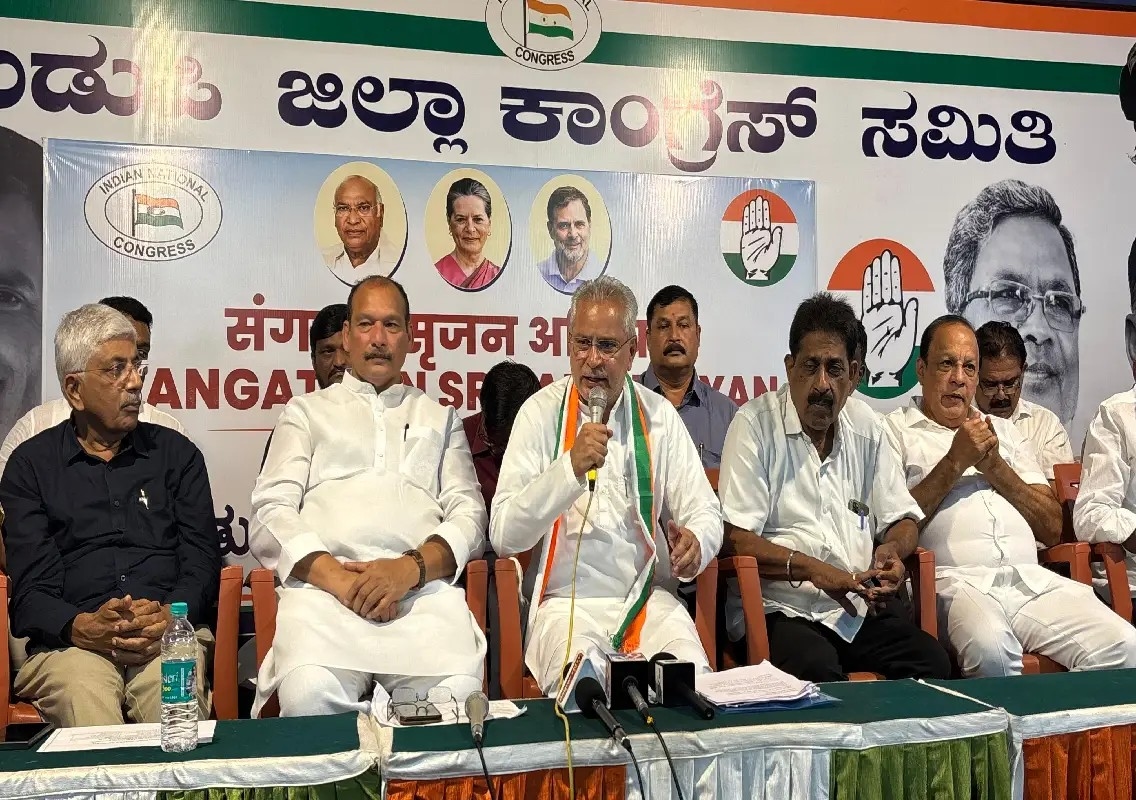


Udupi: The next president of the Udupi District Congress Committee will be chosen based on the preference of grassroots party workers, AICC observer Himmat Singh Patel said on Friday. The announcement came as the All India Congress Committee (AICC) launched a bottom-up organisational exercise aimed at strengthening the party structure and empowering workers at the block level.
Addressing a press conference at the Udupi District Congress Office, Patel said the initiative is part of the “Sangathan Srijan Abhiyan”, a nationwide organisational drive that reflects Leader of the Opposition Rahul Gandhi’s vision of strengthening direct communication between the party’s central leadership and grassroots workers.
AICC launches grassroots-based selection process
Himmat Singh Patel said the campaign has been designed to revitalise the district organisation by ensuring that party workers at the grassroots play a decisive role in selecting their district president.
He said the exercise would cover all 10 Congress blocks in Udupi district, with workers’ opinions carrying significant weight in the selection process.
According to Patel, the initiative is intended to build a stronger and more accountable district leadership by giving local workers a direct voice in choosing the person who will lead the organisation.
Aspirants must apply formally
The AICC observer said party leaders interested in contesting for the post of district president must formally submit their applications.
He added that the selection would be based on clearly defined parameters rather than individual recommendations alone.
According to Patel, three major criteria will determine the suitability of an applicant:
- Majority support from grassroots Congress workers.
- Proven loyalty to the party and its organisation.
- Strong and active engagement with workers across the district.
He said these factors would help identify a leader capable of effectively strengthening the party organisation at the district level.
Observers to assess workers’ feedback
Explaining the selection procedure, Patel said AICC observers would spend at least 10 days visiting various parts of the district to interact with party workers and assess the support enjoyed by each applicant.
The observers will collect feedback from grassroots members across all Congress blocks before preparing a comprehensive report.
The report will then be submitted to the party leadership, following which a high-level review meeting will be held to evaluate the findings and finalise the appointment.
Patel said the process has been structured to ensure transparency and fairness while reflecting the views of party workers.
New district president likely by August-end
The AICC expects to complete the evaluation process and announce the new Udupi District Congress president by the end of August.
Patel reiterated that the final decision would be based on the opinions gathered from grassroots workers during the field assessment rather than relying solely on organisational recommendations.
He expressed confidence that the exercise would strengthen the Congress organisation in Udupi and encourage greater participation from workers at every level.
Senior Congress leaders attend press conference
Several senior Congress leaders were present during the press conference.
Among those in attendance were MLC Ivan D’Souza, former minister Jayaprakash Hegde, Udupi District Congress president Ashok Kumar Kodavoor, KPCC Campaign Committee president Vinay Kumar Sorake, KPCC Campaign Committee district president Harish Kini, Udupi Block Congress president Ramesh Kanchan, Congress leaders Dinesh Hegde Molahalli, Kishan Hegde Kolkebail, Prasadraj Kanchan and other party functionaries.
Conclusion
The Sangathan Srijan Abhiyan marks a significant organisational initiative by the Congress to strengthen its district units through greater involvement of grassroots workers. By adopting a bottom-up approach to leadership selection, the party aims to build a stronger organisational structure and ensure that local leadership reflects the confidence and support of its cadre.