







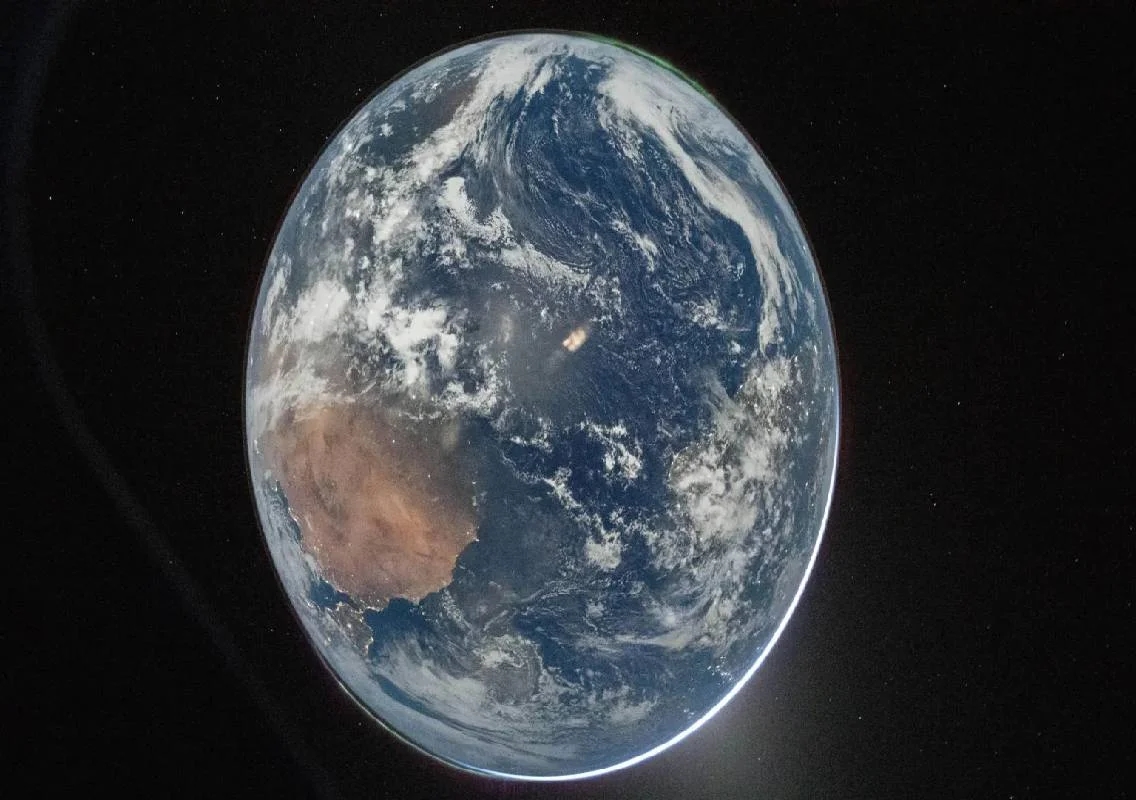


United States: In a historic moment for modern space exploration, NASA has released the first high-resolution images of Earth captured by the crew of its Artemis II mission as they journey towards the Moon. The images, described as “spectacular” by the agency, offer a rare and breathtaking perspective of our planet from deep space — a sight not witnessed by humans since 1972.
The photographs were taken by Artemis II mission commander Reid Wiseman shortly after the spacecraft completed a critical manoeuvre known as the trans-lunar injection burn. This engine firing pushed the Orion spacecraft out of Earth’s orbit and set it on a trajectory towards the Moon, marking a significant milestone in the mission.
The first image, titled “Hello, World,” showcases Earth in striking detail. The Atlantic Ocean dominates the frame, surrounded by a delicate halo of atmosphere glowing against the darkness of space. Adding to the visual spectacle are green auroras shimmering near both poles.
Interestingly, the Earth appears upside down in the image. The western Sahara and the Iberian Peninsula can be seen to the left, while the eastern coastline of South America lies to the right. A bright celestial object visible in the lower right corner was identified by NASA as the planet Venus.
The images were captured in the early hours of Friday, soon after the successful engine burn, which is considered one of the most critical phases of the mission.
Journey beyond Earth orbit after five decades
Artemis II marks a historic return of human spaceflight beyond Earth’s orbit, something that has not occurred since the era of the Apollo 17 mission. The current crew of four astronauts is travelling over 2 lakh miles (approximately 3.2 lakh kilometres) to the Moon aboard the Orion spacecraft.
The mission is designed as a looping journey that will take the crew around the far side of the Moon before returning to Earth. According to mission timelines, the spacecraft is expected to pass the Moon’s far side on April 6 and return safely on April 10.
Astronauts captivated by the view
Following the successful manoeuvre, the astronauts reportedly spent considerable time observing Earth from the spacecraft windows. Mission specialist Jeremy Hansen described the experience to mission control in Houston, saying the crew was “glued to the windows.”
He noted the extraordinary view of the Earth’s dark side illuminated faintly by reflected light from the Moon. The excitement among the crew was so intense that commander Wiseman later contacted mission control with a practical concern — how to clean the spacecraft windows, which had become smudged due to constant use.
Initially, capturing images posed a technical challenge. Wiseman explained that photographing Earth from such a distance required careful adjustment of exposure settings. He compared it to trying to take a photograph of the Moon from one’s backyard — a task that appears simple but requires precision.
However, as the mission progressed, the crew managed to overcome these challenges and capture clearer, more detailed images.
Striking images of light and darkness
Among the subsequent photographs shared by NASA is a dramatic image of Earth divided between daylight and darkness. This boundary, known scientifically as the terminator, highlights the transition between the sunlit and shadowed portions of the planet.
Another image reveals Earth almost entirely in darkness, dotted with clusters of artificial lights from cities across continents. These glowing networks underscore human presence and activity, even when viewed from vast distances in space.
NASA also released a side-by-side comparison of the new images with similar photographs taken during the Apollo 17 mission in 1972. The comparison highlights technological advancements over the past 54 years while reinforcing a timeless observation — Earth remains stunningly beautiful when viewed from space.
“We’ve come so far in the last 54 years, but one thing hasn’t changed: our home looks gorgeous from space,” NASA noted in its statement.
A step towards future lunar missions
The Artemis II mission is a crucial step in NASA’s broader Artemis programme, which aims to establish a sustained human presence on the Moon and eventually pave the way for missions to Mars. While Artemis II itself does not involve a lunar landing, it serves as a vital test of systems and crew capabilities in deep space conditions.
The successful capture of these images not only demonstrates advancements in imaging technology but also rekindles global interest in human space exploration. As the mission continues, scientists and enthusiasts alike are expected to gain further insights into both the spacecraft’s performance and the awe-inspiring views of our planet from beyond its orbit.
Conclusion
The release of these high-resolution images marks a defining moment in contemporary space exploration. Beyond their scientific value, the photographs serve as a reminder of Earth’s fragility and beauty, seen from a perspective few have experienced. As Artemis II continues its journey, it brings humanity one step closer to a new era of exploration beyond our home planet.