


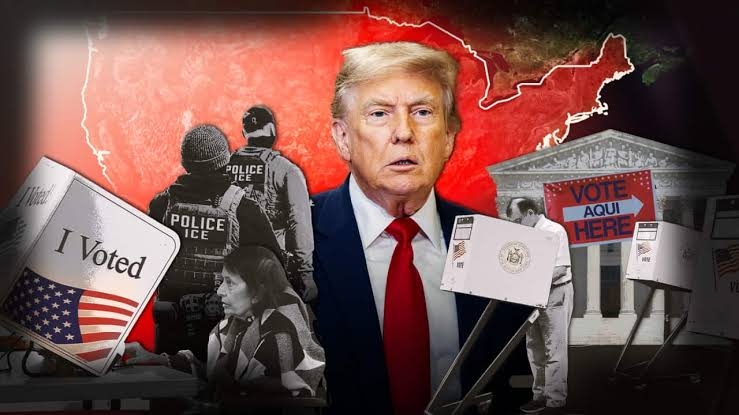


Washington: US President Donald Trump is not on the ballot in the midterm elections scheduled for Tuesday, November 3, but the results could have major consequences for his second term. A strong performance by Democrats could cost Republicans control of the House of Representatives or the Senate, limiting Trump’s ability to pass legislation, confirm appointments and advance his political agenda.
Five issues have emerged as central to the election debate: the Iran war, inflation and the cost of living, healthcare, artificial intelligence and the rapid expansion of data centres. Together, they reflect voters’ concerns about household expenses, economic security and the direction of the administration’s policies.
Trump’s approval rating and the political mood
Trump enters the midterm campaign with weak approval ratings, although his support among Republican voters remains considerably stronger than his standing among the wider electorate.
A Reuters/Ipsos poll conducted in September put his approval rating at 32%, then the lowest of his political career. A later poll completed on October 26 recorded a slight recovery to 32%, up one percentage point, but still showed significant dissatisfaction. The same October survey found Democrats leading Republicans on the generic congressional ballot among registered voters, 47% to 36%. Reuters+1
The broader polling picture suggests that economic concerns and dissatisfaction with the administration’s handling of key issues could influence voting decisions. A Gallup survey conducted in October found that the economy and healthcare were each considered extremely important by half of registered voters, while 47% gave the same rating to the situation in Iran. Gallup.com
The central question for Republicans is whether Trump’s support among his core voters will be enough to offset dissatisfaction among independents and voters who are less firmly aligned with either party.
1. The Iran war and rising fuel prices
The conflict involving the United States and Iran has become a significant political issue, partly because of its impact on fuel prices and household expenses.
The increase in petrol and diesel prices has connected a foreign policy decision directly to the financial concerns of American households. Higher fuel costs can also affect transportation, distribution and the prices consumers pay for goods.
A Gallup survey released in October placed the situation in Iran among the three leading concerns for voters, alongside the economy and healthcare. Nearly half of registered voters described it as extremely important to their midterm vote. Gallup.com
The conflict has also faced growing public opposition. The September Reuters/Ipsos poll that recorded Trump’s 32% approval rating found that only 34% of respondents supported the US strikes on Iran, while 82% believed the conflict would continue for an extended period. Reuters
The administration is pursuing diplomatic options while keeping military choices open. According to reporting cited in the source article, Trump currently favours negotiations, while Israeli Prime Minister Benjamin Netanyahu has pressed for further military action after the election. Trump has said he wants to avoid additional deaths if possible.
The issue presents a challenge for Republicans because voters may judge the administration not only on its foreign policy objectives but also on the economic consequences of the conflict.
2. Inflation and the cost of living
The cost of living is another major concern heading into the election. Inflation reduces the purchasing power of households when prices rise faster than incomes, leaving consumers with less money to spend on other needs.
For many voters, the issue is not simply the overall state of the economy but the amount they pay for groceries, fuel, housing and everyday services.
An August Reuters/Ipsos survey found that 47% of registered voters considered the cost of living the single most important factor in deciding their midterm vote. The same survey found that 71% of US adults disapproved of Trump’s handling of the issue, compared with 22% who approved. Ipsos
The dissatisfaction has continued in more recent polling. An AP-NORC survey conducted in October found that 79% of voters disapproved of Trump’s handling of the cost of living, while 74% disapproved of his handling of the economy. AP-NORC
Trump has sought to shift attention towards economic performance, with administration officials undertaking an affordability-focused campaign. Republicans argue that tax cuts and lower energy prices can provide relief to households.
However, the administration faces the challenge of convincing voters that its policies are improving their financial circumstances. For people dealing with higher supermarket bills and fuel costs, the practical impact of economic policy may matter more than broader claims about growth.
3. Healthcare costs and insurance subsidies
Healthcare is a major election issue because millions of Americans depend on health insurance arrangements that can be affected by federal policy.
Many Americans receive insurance through their employers, while others purchase coverage through marketplaces established under the Affordable Care Act (ACA), commonly known as Obamacare.
The debate over enhanced ACA subsidies has become particularly contentious. Congress adjourned without extending the additional financial assistance, leaving millions of people facing higher insurance premiums. The source article puts the number affected at approximately 22 million.
The disagreement over the subsidies also contributed to a record 43-day government shutdown, with Republicans arguing that the additional assistance was pandemic-era spending that should be allowed to expire. Some Republican lawmakers representing competitive districts, however, supported extending the subsidies.
Healthcare costs are also an area where polling suggests Democrats have an advantage. A KFF survey found that registered voters trusted Democrats over Republicans to handle healthcare costs by 42% to 22%. The survey also showed Democrats holding an advantage on the broader cost of living. KFF
Medicaid, the government health insurance programme for low-income Americans, is another part of the debate. Changes and reductions linked to Trump’s tax-and-spending legislation have raised concerns about access to healthcare and the financial impact on beneficiaries.
For voters facing higher premiums or uncertainty over coverage, healthcare policy could become an important consideration when choosing congressional candidates.
4. Artificial intelligence and fears over jobs
Artificial intelligence has emerged as a more prominent political issue as its use expands across workplaces, businesses and public services.
The debate involves two broad concerns: whether the United States can maintain its lead in AI development and how the technology could affect jobs, privacy and public safety.
Trump has prioritised maintaining America’s technological advantage over China, while critics have called for stronger regulation to address the risks associated with rapid AI development.
Public opinion suggests that many Americans want greater oversight. A Pew Research Center study found that 67% of US adults had little or no confidence in the federal government to regulate AI effectively. It also found that 71% expected AI to lead to fewer jobs in the United States over the next 20 years. Pew Research Center+1
The question of employment is particularly important because AI tools are increasingly being used to automate tasks that were previously performed by people. While supporters point to productivity gains and new opportunities, concerns remain about job losses and the pace at which workers can adapt.
The political debate is also attracting significant financial backing from the technology industry. The pro-AI super PAC Leading the Future has reportedly raised $125 million to oppose candidates favouring stricter regulation.
The disagreement places candidates in a difficult position: they must address public concerns about AI while considering the economic and strategic importance of remaining competitive in the technology sector.
5. Data centres and rising electricity demand
The expansion of AI has created another political issue: the construction of large data centres.
These facilities house the computer systems that support AI applications, cloud services and other digital operations. They require substantial amounts of electricity, and their growing power requirements have raised concerns about pressure on local energy infrastructure and household bills.
Opposition to new data centres in residential communities has become increasingly visible. A September Quinnipiac University poll found that 72% of Americans opposed building an AI data centre in their community, compared with 21% who supported such a project. Quinnipiac University Poll
A separate survey by the University of Pennsylvania’s Annenberg Public Policy Center found that 61% of Americans opposed the construction of new data centres in their area. The survey also found that opposition crossed party lines, with majorities of Democrats, Republicans and independents expressing concern. annenbergpublicpolicycenter.org
Trump has defended the expansion of data centres, arguing that blocking development could weaken America’s position in the global technology competition. He has warned that voters who oppose such projects could be helping China.
Vice President JD Vance has acknowledged that local opposition is often linked to concerns about higher electricity bills. Trump and some state governors have encouraged data centre developers to arrange their own power supplies or generate electricity independently.
The issue creates a tension between the economic benefits of AI infrastructure and the concerns of communities that may have to accommodate energy-intensive facilities. As a result, data centre construction could become a local campaign issue in areas where residents are worried about electricity costs and the impact on their surroundings.
How the five issues are connected
Although the five issues involve different areas of public policy, several are closely linked to household finances.
The Iran war has implications for fuel prices. Inflation affects groceries and other daily expenses. Healthcare policy influences insurance premiums, while AI raises questions about employment and economic security. Data centres have brought electricity costs and local infrastructure into the political debate.
This overlap helps explain why affordability has become a recurring theme in the election campaign. Voters may assess the administration’s performance through the costs they face in their everyday lives, even when the underlying policy decisions involve international relations or technological development.
Polling also indicates that different voter groups attach different levels of importance to these subjects. Gallup’s October survey found that Democrats were particularly concerned about healthcare and the economy, while Republicans placed greater emphasis on immigration and crime. Independents ranked the economy, healthcare and Iran among their leading priorities. Gallup.com
What could change the election outcome?
Despite the polling trends, the results are not predetermined. Turnout, local candidates, campaign organisation and late decisions by voters can all influence the outcome in closely contested constituencies.
Republicans are also seeking to draw attention to issues where they believe the administration has stronger public support, particularly immigration and crime. These subjects could help mobilise voters who remain supportive of Trump’s policies.
The balance of power in Congress will be particularly important. If Democrats take control of either chamber, they could restrict the administration’s legislative options, increase scrutiny of federal agencies and launch investigations into its policies. A change in control could therefore have consequences well beyond the immediate election results.
Voting takes place on Tuesday, November 3, 2026. Results will begin arriving after polling stations close, although close contests may take longer to call as officials count ballots and complete verification.
Ultimately, the midterms will provide an important measure of public sentiment towards Trump’s second term. The five issues dominating the debate suggest that voters will be weighing foreign policy, economic management, healthcare, technological change and the cost of energy as they decide which party should control Congress.