







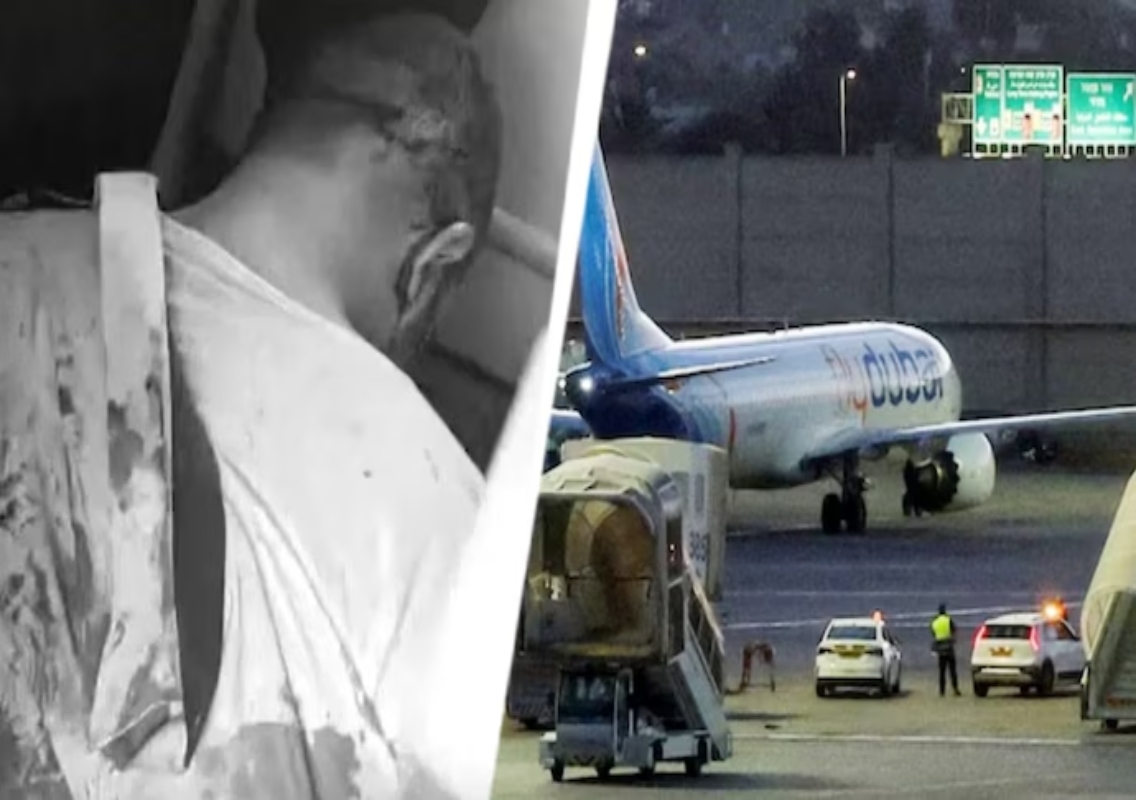


New Delhi: The Omani co-pilot accused of attacking Indian Captain Smit Machchhar during a Flydubai flight from Dubai to Tel Aviv has been identified as Hamam Al-Hammami, according to Saudi broadcaster Al Arabiya, which cited sources familiar with the investigation.
The identification comes days after Flydubai flight FZ1073 was forced to make an emergency landing in Tabuk, Saudi Arabia, following a violent cockpit incident on September 30. The co-pilot allegedly stabbed Machchhar and attempted to take control of the Boeing 737 MAX 8 before passengers and crew intervened.
The case has triggered investigations involving authorities in Saudi Arabia, the United Arab Emirates, Israel, Oman and other countries. Questions have also emerged about how the co-pilot was cleared to operate an international passenger flight after reports that he had previously been prevented from flying in Oman over concerns about his views.
Co-pilot identified as Hamam Al-Hammami
Al Arabiya, citing sources, reported that the suspect was identified as Hamam Al-Hammami, an Omani national. Other reports, including those from US and Indian media, have independently carried the same identification while noting that the investigation remains underway.
According to a person familiar with the matter cited by India Today, Al-Hammami had previously been barred from flying in Oman over concerns that he had adopted extremist views. The same source said he was subsequently hired by the UAE-based airline Flydubai.
The circumstances surrounding his employment and aviation clearance are now part of the wider investigation. The reported previous restriction does not by itself establish why he was later permitted to work as a commercial pilot or whether authorities were aware of the earlier concerns.
What happened aboard Flydubai flight FZ1073?
Flight FZ1073 was travelling from Dubai to Tel Aviv on September 30 when a violent confrontation broke out inside the cockpit.
According to accounts reported by Indian and international media, the co-pilot allegedly attacked Captain Smit Machchhar with a sharp object and attempted to interfere with the aircraft’s controls.
The aircraft subsequently went into a rapid descent. India Today reported that the Boeing 737 MAX 8 plunged by nearly 14,000 feet during the incident. Other reports have given somewhat different figures for the altitude loss, reflecting differences in flight-data accounts and passenger recollections.
Despite suffering serious injuries, Machchhar managed to activate the cockpit door mechanism, allowing people outside the cockpit to enter.
Passengers and crew members then helped restrain the attacker. Off-duty pilots travelling on the aircraft also assisted in stabilising the plane and taking control of the flight.
Indian captain Smit Machchhar injured
Captain Smit Machchhar, an Indian national, was seriously injured during the attack.
Machchhar joined Flydubai in June 2022 as a direct-entry captain after spending nearly 11 years with SpiceJet. Sources previously told India Today that he was a Boeing 737 fleet specialist with experience in safety and compliance and had also mentored other pilots.
After the incident, Machchhar was taken for medical treatment. He later spoke to Prime Minister Narendra Modi from his hospital bed and described how he managed to open the cockpit door during the attack.
Reuters reported that Machchhar told Modi that the aircraft had rapidly descended and that, despite his injuries, he managed to open the door, enabling passengers and others to intervene.
Passengers helped overpower the attacker
The passengers’ intervention became a crucial part of the incident.
People aboard the aircraft described a sudden descent and confusion inside the cabin. Once the cockpit door opened, passengers entered and helped restrain the co-pilot.
An off-duty pilot and other crew members helped stabilise the aircraft while the injured captain received assistance.
The plane was eventually diverted to Tabuk Airport in Saudi Arabia, where it landed safely. The passengers later continued their journey to Israel on another flight.
Saudi authorities detained the co-pilot following the emergency landing, while investigations into the incident continued.
Previous concerns about the co-pilot
One of the most significant new developments is the report that Al-Hammami had previously been prevented from flying in Oman.
India Today reported that a person familiar with the matter said Oman had barred him from flying after concerns that he had adopted extremist views. The person spoke on condition of anonymity because the investigation remains active.
ABC News, citing senior intelligence and law-enforcement officials, also reported that the suspect had previously been suspended by Oman Air after being identified as a security risk. The report identified him as 29-year-old Hamam Al Hammami.
The reports have raised questions about pilot screening, information-sharing between aviation authorities and the procedures used when crew members move between airlines or countries.
However, the precise circumstances of his earlier restriction, subsequent employment and aviation clearance have not been fully established publicly.
Terror angle remains under investigation
The incident has also triggered an investigation into whether the cockpit attack was connected to terrorism.
Israeli Prime Minister Benjamin Netanyahu described the incident as a terrorist attack and said the co-pilot had undergone radical Islamist indoctrination. Reuters reported that Israeli authorities were investigating the attack and its possible motivations.
The UAE has also been investigating the incident. Saudi authorities are involved because the aircraft landed in Tabuk following the emergency.
At this stage, claims about the suspect’s ideology, motivation or possible organisational links should be treated as part of the ongoing investigation rather than as established facts.
US President Donald Trump has also raised the possibility of an Iranian connection, but available reporting has not established evidence linking Iran to the incident.
Aviation security concerns grow
The incident has renewed attention on the threat posed by insiders in aviation.
Since the September 11, 2001 attacks, cockpit doors on commercial aircraft have been strengthened and procedures have been introduced to prevent unauthorised access. Those measures are primarily designed to protect aircraft from people attempting to enter the cockpit from the cabin.
The Flydubai incident presents a different scenario because the alleged attacker was already inside the cockpit and had authorised access to the aircraft’s controls.
The case could therefore prompt aviation authorities and airlines to review crew screening, psychological and security assessments, information-sharing and continuing monitoring of pilots.
The investigation may also examine how authorities can balance strict security procedures with the operational requirements of commercial aviation.
Investigation continues across countries
The incident involves multiple jurisdictions because the flight originated in the UAE, was bound for Israel, landed in Saudi Arabia and involved an Omani national and an Indian captain.
Authorities are therefore examining different parts of the case, including the co-pilot’s background, employment history, previous aviation restrictions, the events inside the cockpit and the aircraft’s rapid descent.
For now, the identification of Hamam Al-Hammami adds an important piece to the investigation, but it does not by itself answer why the attack occurred or how the co-pilot was able to serve on the flight.
The focus is now expected to remain on establishing the sequence of events, determining the motive and examining whether earlier concerns about the co-pilot should have prevented him from operating a passenger flight.