


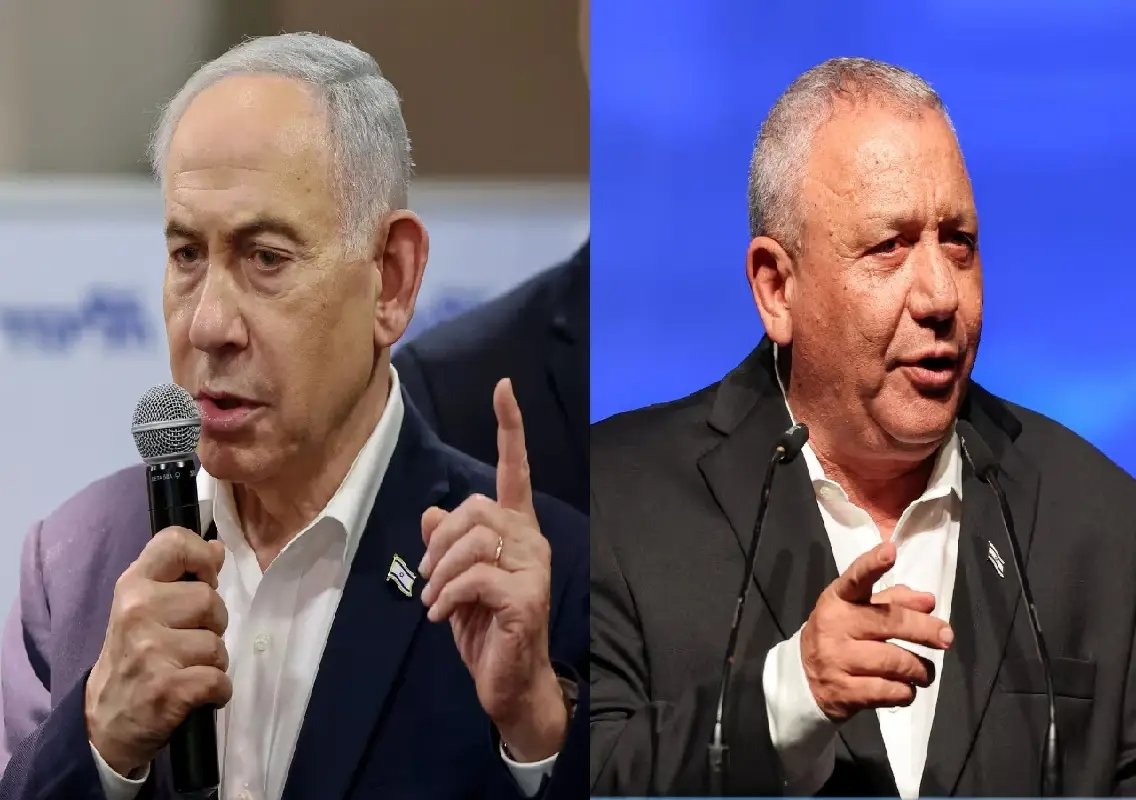


Israel: Israel’s general election has left Prime Minister Benjamin Netanyahu‘s political bloc and that of his main challenger, former military chief Gadi Eisenkot, short of the majority required to form a government, setting the stage for potentially weeks of coalition negotiations.
Exit polls released by the country’s three main television broadcasters indicated that neither bloc was projected to secure the 61 seats needed for a majority in the 120-member Knesset, Israel’s parliament. The projections gave Netanyahu’s bloc between 50 and 52 seats, while Eisenkot’s bloc was estimated to win between 49 and 53 seats.
Arab-led parties, which are outside both major blocs, were projected to secure between 17 and 19 seats, potentially giving them a decisive role in determining the next government.
The results remain subject to the final vote count and official allocation of parliamentary seats. Neither bloc had secured a clear path to a majority based on the exit polls, leaving the country facing uncertainty over who will lead the next government.
Turnout reached 77.7%, the highest in more than two decades, according to Israel’s Central Elections Committee. Netanyahu, 77, the country’s longest-serving prime minister, will remain in office as caretaker until a new government takes over.
Neither bloc secures a clear majority
The Knesset has 120 seats, meaning a government generally needs the support of at least 61 lawmakers to command a parliamentary majority.
According to Reuters, broadcasters Kan 11 and Channel 13 projected Netanyahu’s bloc and Eisenkot’s bloc at 51 seats each. Channel 12 gave Netanyahu’s bloc 52 seats and the opposition bloc 49, with Arab-led parties projected to take the remaining 19.
The projections shifted during election night, with one broadcaster initially placing Eisenkot ahead before giving Netanyahu’s bloc a narrow advantage.
Although Likud, Netanyahu’s party, was expected to emerge as the largest individual party, that position alone does not guarantee the prime minister a new term. The ability to assemble a coalition with sufficient parliamentary support will be crucial.
Eisenkot’s Yashar party was projected to finish second, according to Bloomberg. Both leaders had staked claims to lead the next government, but neither had declared victory, Reuters reported.
The Arab-led parties could become central to the negotiations. In projections showing the two main blocs tied at 51 seats each, both would need support from at least 10 additional lawmakers to reach the 61-seat threshold.
That support could come from Arab-led parties or from lawmakers associated with the rival bloc, depending on the political alignments that emerge after the final results.
Why Israel relies on coalition governments
Israel’s electoral system helps explain why election results frequently lead to complex negotiations rather than an outright winner.
Voters cast ballots for political parties rather than individual candidates representing geographical constituencies. Parliamentary seats are allocated through proportional representation, broadly reflecting each party’s share of the national vote.
The entire country functions as a single electoral district. This allows parties representing different political, religious, social and ideological groups to win seats in the Knesset, even when their support is spread across the country.
To enter parliament, a party must receive at least 3.25% of valid votes. Parties that fail to cross the threshold do not qualify for seats, making the final count important not only for determining each party’s support but also for deciding which lists enter the Knesset.
According to the Israel Democracy Institute, no single party or electoral list has won an outright majority in the Knesset since Israel’s first parliamentary election in 1949.
The closest an electoral list came was in 1969, when the Alignment, an alliance of left-wing parties, won 56 seats with 46.2% of the vote.
The proportional representation system, combined with Israel’s fragmented political landscape, has resulted in numerous parties competing for parliamentary representation. Larger parties consequently depend on smaller political groups to secure the numbers needed to govern.
Netanyahu’s outgoing coalition held 68 seats at its peak, illustrating how a governing majority can depend on agreements between parties with different priorities.
When will the final election results be announced?
The exit polls provide an early indication of the likely outcome but are not the official results. The final allocation of seats depends on the complete national vote count and the number of parties that cross the electoral threshold.
The final tally is expected by Friday, October 30, while the official results are scheduled for publication on November 4, a week after the election.
Partial counts released through Wednesday showed the vote shares of individual parties, but they did not yet establish the final distribution of seats.
The distinction is important because even relatively small changes in the national vote can affect which parties qualify for parliamentary representation and how seats are allocated among the competing lists.
Once the official results are published, the focus will shift to President Isaac Herzog’s consultations with political parties and the process of identifying a candidate capable of forming a government.
President Herzog to nominate a candidate
After the results are confirmed, Herzog will consult political party leaders to determine whom they recommend for prime minister.
The president will then ask the candidate he believes has the best chance of assembling a government to attempt to form a coalition. While this is often the leader of the largest party, it is not an automatic requirement.
The candidate’s prospects will depend on the commitments and positions of other parties, including those that may be willing to join a coalition, support a government from outside it or abstain during a parliamentary confidence vote.
For Netanyahu, the challenge will be to bring together enough partners to secure the necessary support in the Knesset. Eisenkot faces a similar task if he is given the opportunity to form the government.
The presence of Arab-led parties outside the two main blocs could prove particularly significant if the leading camps remain close in seat numbers.
However, the final outcome will depend on the official results and the willingness of political parties to negotiate agreements on government formation and policy priorities.
Coalition negotiations could last up to 42 days
The candidate nominated by Herzog will initially have 28 days to form a government, with the possibility of a 14-day extension. This creates a maximum period of 42 days for the nominee to secure an agreement, according to AFP.
Coalition negotiations can be complicated because smaller parties may hold the seats needed to turn a minority bloc into a parliamentary majority.
In exchange for joining a coalition, parties may seek cabinet positions, budget commitments or assurances on specific policy issues. Negotiations can also involve disagreements over security, economic priorities, religious affairs and other questions central to Israeli politics.
Previous election cycles have demonstrated how difficult coalition-building can become when no bloc commands a clear majority. Negotiations have sometimes lasted weeks or months, and a candidate who fails to form a government may be followed by another nominee.
The current caretaker government will continue functioning during the process, ensuring that public services and routine administration remain in place.
Could Israel form a minority government or hold another election?
A government does not necessarily need to have 61 members formally participating in its coalition. It must, however, secure sufficient parliamentary support to win the required vote in the Knesset.
A minority government could take office if it receives backing from lawmakers outside the coalition or if enough members abstain during the confidence vote. Arab-led parties could therefore influence the outcome without necessarily joining a governing coalition.
Such a government would need to rely on cooperation from other parties to pass legislation and advance its agenda, potentially making parliamentary business more difficult.
Another possibility is a power-sharing arrangement between rival leaders. In 2020, following three elections in less than a year, Netanyahu and former military chief Benny Gantz agreed to form a national unity government with a plan to rotate the prime minister’s position. The arrangement broke down after about a year, leading to another election.
If no candidate succeeds in forming a government under the applicable procedures, Israel could be forced to hold another election, potentially early next year, according to the Associated Press.
Israel experienced repeated electoral stalemates between April 2019 and November 2022, when the country held five elections.
Key dates in Israel’s government formation process
- October 30: Expected completion of the final vote tally.
- November 4: Scheduled publication of official election results.
- After the results: President Isaac Herzog consults party leaders and selects a candidate to attempt to form a government.
- Up to 42 days after nomination: The candidate may use the initial 28-day period and a possible 14-day extension to assemble a coalition.
- After coalition formation: The government must win the required vote in the Knesset before taking office.
The election has produced a high turnout but no immediate resolution to Israel’s political contest. With both major blocs short of a projected majority, the final seat allocation and the decisions of smaller parties will shape the next phase.
Until a new government is formed and approved by parliament, Netanyahu will remain caretaker prime minister, leaving Israel facing a period of political uncertainty.