







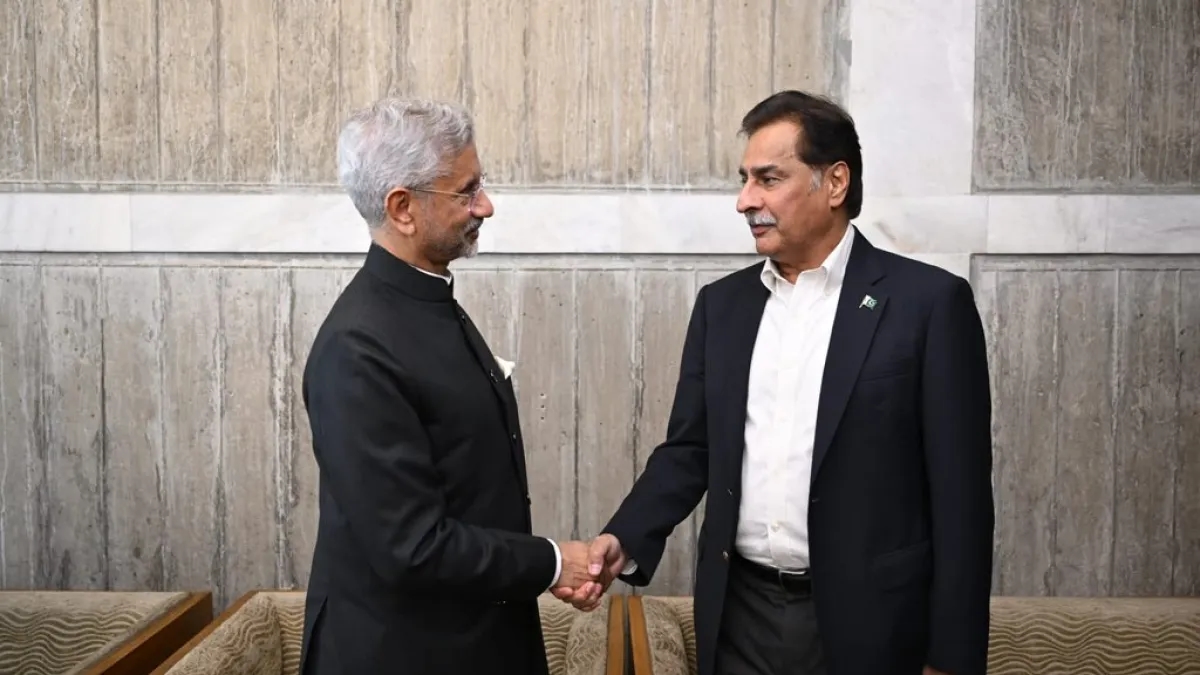


India’s External Affairs Minister Subrahmanyam Jaishankar drew wide attention after publicly shaking hands with Ayaz Sadiq, a senior Pakistani leader, during a gathering in Dhaka on December 31, the final day of 2025.
The brief interaction took place at Bangladesh’s parliament complex, where regional leaders had assembled to attend the funeral of former Bangladesh prime minister Khaleda Zia. Images of the handshake, shared by Pakistani and Bangladeshi officials, quickly went viral and triggered intense discussion across South Asia.
A rare public gesture
According to Sadiq, Jaishankar approached him in a waiting room after greeting delegations from Nepal, Bhutan and the Maldives. The Pakistani leader described the exchange as polite and deliberate, noting that it occurred in full view of other diplomats.
The gesture stood in contrast to recent sporting and diplomatic snubs, including incidents where Indian and Pakistani cricket teams avoided handshakes amid strained relations.
Context of strained relations
India–Pakistan ties have sharply deteriorated over recent years, hitting a low point after a deadly attack in Pahalgam in April 2025, followed by a four-day aerial conflict in May. India blamed Pakistan for the attack, suspended the Indus Waters Treaty, and accused Islamabad of backing cross-border militancy — charges Pakistan denies.
Since then, rhetoric on both sides has remained harsh, with missile tests, military exercises and diplomatic stand-offs deepening mistrust.
Differing interpretations
Some Indian commentators criticised the handshake as unnecessary, while voices in Pakistan viewed it as a modest but welcome signal. Islamabad-based analyst Mustafa Hyder Sayed called it a “bare minimum” gesture of normal diplomatic courtesy that had been missing since the conflict.
Former Pakistani diplomat Sardar Masood Khan suggested such an interaction would not have occurred without approval from India’s top leadership, hinting at cautious recalibration.
However, Indian foreign affairs editor Rezaul Hasan Laskar downplayed its significance, calling it a routine exchange that should not be overstated. He also noted that no images were released by Indian official channels.
Symbolism more than substance?
While analysts differ on whether the moment signals a potential thaw, most agree it does not amount to a policy shift. With no sustained dialogue since the 2008 Mumbai attacks, trust remains low and structural issues unresolved.
Still, the handshake has reignited debate over whether 2026 could see limited engagement between the two nuclear-armed neighbours — or whether it was simply a fleeting diplomatic courtesy in a tense relationship.