


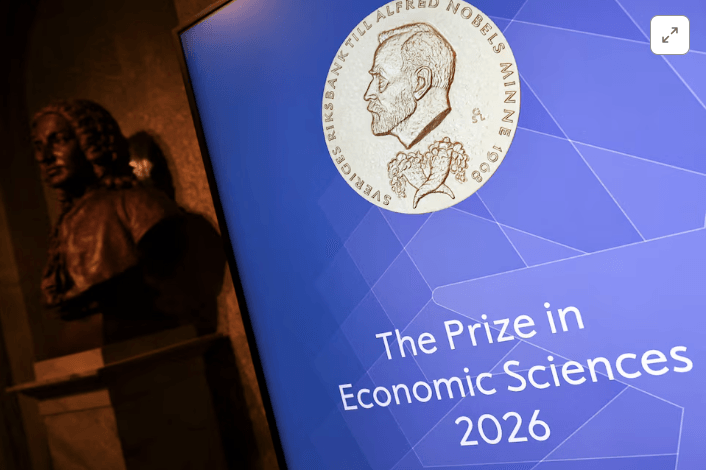


Stockholm: American economists Robert Hall and Michael Woodford have won the 2026 Nobel Prize in Economic Sciences for their work on the microeconomic foundations of macroeconomic stabilisation, the Royal Swedish Academy of Sciences announced on Monday, October 12.
Their research has contributed to the development of economic models that help governments and central banks design more effective policies to manage economic fluctuations. Such models can support better-timed decisions on interest rates, government spending and other policy measures intended to limit the damage caused by economic shocks.
The award, formally known as the Sveriges Riksbank Prize in Economic Sciences in Memory of Alfred Nobel, carries a prize amount of 12 million Swedish kronor, equivalent to approximately $1.2 million.
The economics award is the final Nobel prize to be announced in 2026. The academy said the laureates’ work provides a theoretical foundation for models used by central banks and governments around the world.
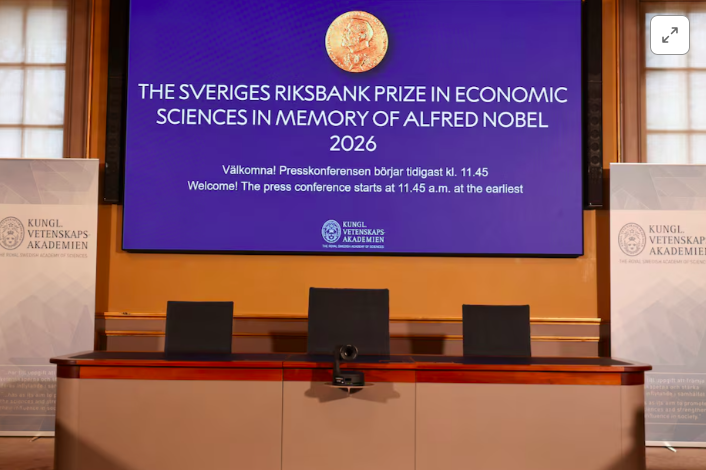
Research helps strengthen economic stabilisation
Macroeconomic stabilisation refers to policies intended to reduce severe fluctuations in economic activity, including periods of recession, high inflation or sudden changes in demand.
Governments and central banks use fiscal and monetary measures to respond to these developments. Fiscal policy includes decisions on government spending and taxation, while monetary policy typically involves interest rates and measures affecting credit and financial conditions.
However, the effectiveness of such interventions depends on how households and businesses respond to policy changes. Decisions about consumption, saving, investment and employment influence how an economy reacts to changes in interest rates, public spending and other economic conditions.
Hall and Woodford’s work on the microeconomic foundations of macroeconomic stabilisation has helped strengthen the theoretical models used to understand these relationships.
John Hassler, chair of the Committee for the Prize in Economic Sciences, said the laureates’ research had provided a stable theoretical foundation for models used by policymakers worldwide.
“With them, we are better equipped to deal with shocks in the economy, such as energy crises or sudden changes in how much households consume,” Hassler said in a statement.
The recognition highlights the importance of economic research in helping policymakers assess how different interventions may affect households, businesses and the wider economy.
Why microeconomic foundations matter
Microeconomics examines the decisions made by individuals, households and businesses, while macroeconomics studies the economy as a whole, including inflation, unemployment, economic growth and national output.
The two fields are closely connected. Changes in household spending, for example, can influence overall demand, while decisions by businesses about investment and employment can affect production and economic growth.
Economic models that incorporate individual decision-making can help policymakers understand how these separate choices combine to produce wider economic outcomes.
This becomes particularly important during periods of uncertainty. A sudden rise in energy prices can increase production costs and household expenses, while a sharp decline in consumer spending can reduce business revenues and slow economic activity.
Policymakers must assess these effects when deciding how to respond. The models informed by research into economic stabilisation provide a framework for analysing possible outcomes and the consequences of different policy choices.
The Nobel recognition underscores the role of theoretical economics in improving the tools available to governments and central banks, although no model can eliminate uncertainty or guarantee that a policy response will succeed in every situation.
Fiscal and monetary policy in times of crisis
Economic stabilisation policies become especially important when economies experience sudden shocks.
During a downturn, governments may consider measures to support demand, while central banks may adjust interest rates depending on inflation and growth conditions. During periods of high inflation, policymakers may instead seek to moderate demand and prevent price increases from becoming entrenched.
These decisions involve trade-offs. Measures intended to stimulate economic activity can also affect inflation, while policies designed to reduce inflation may slow borrowing, consumption and investment.
The effectiveness of a response also depends on timing. A measure introduced too late may have limited impact, while an intervention that is poorly calibrated could create additional economic pressures.
The research recognised by the 2026 prize contributes to the theoretical framework used to analyse these challenges. By improving understanding of how individual economic decisions influence broader outcomes, such models can help policymakers evaluate the likely effects of their actions.
However, actual policy decisions must also account for changing economic conditions, incomplete information and differences between countries.
Economics prize is separate from the original Nobel awards
The Nobel Prize in Economic Sciences differs from the five original Nobel awards established through the will of Swedish industrialist and dynamite inventor Alfred Nobel in 1895.
The economics prize was established by Sweden’s central bank and was first awarded in 1969. Its official name reflects its status as a memorial award in Alfred Nobel’s memory.
Although it is commonly referred to as the Nobel economics prize, it is formally separate from the original awards for physics, chemistry, physiology or medicine, literature and peace.
Over the decades, the economics prize has recognised research across a wide range of fields, including economic growth, financial crises, labour markets, poverty, institutions and market design.
The majority of previous laureates have been from the United States. Claudia Goldin, who won in 2023 for research on women’s labour market outcomes, remains the most recent woman to receive the award, according to the information provided in the report.
Previous winners examined innovation and growth
The 2025 economics prize went to Joel Mokyr, Philippe Aghion and Peter Howitt for their work on innovation-driven economic growth and the role of technological progress in improving living standards.
Their research examined how innovation and the introduction of new technologies can transform production and support long-term economic development.
The 2026 award focuses on a different but related challenge: how policymakers can respond to economic fluctuations and reduce the damage caused by sudden shocks.
Together, the topics illustrate the range of questions examined by economists, from the forces that sustain growth over decades to the policies used to manage instability in the shorter term.
Final Nobel announcement of 2026
The announcement of Hall and Woodford as this year’s economics laureates concludes the 2026 Nobel prize announcements.
Their work has particular relevance at a time when governments and central banks continue to confront uncertainty over inflation, energy prices, consumer demand and economic growth.
The award recognises the contribution of economic theory to understanding how policy decisions affect the wider economy. By strengthening the foundations of models used to study stabilisation, Hall and Woodford have helped advance the analytical tools available to policymakers.
The prize does not mean that economic fluctuations can be prevented entirely. Instead, it recognises research that can help governments and central banks better understand economic shocks and assess responses intended to limit their effects.