


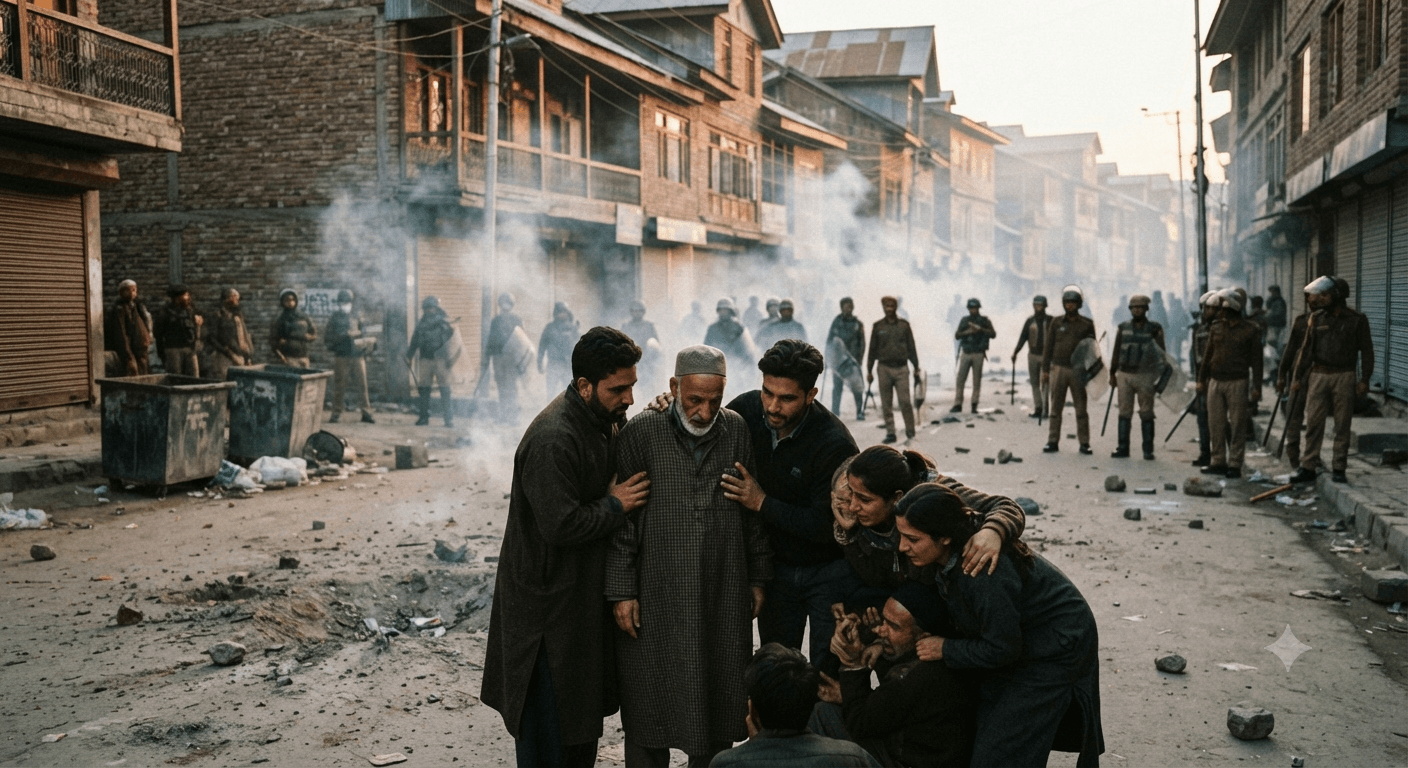


Rawalakot: At least seven civilians were reportedly killed and 23 others injured after Pakistani security forces used firearms and armed drones during a crackdown on protesters in Pakistan-occupied Kashmir (POK), triggering widespread anger on social media. Videos showing burning buildings, demonstrations and mourners carrying the bodies of those killed have prompted some Pakistani and Kashmiri voices to compare the security operation with Israel’s military actions in Gaza.
The reported violence took place in Rawalakot on Thursday, November 5, as Pakistani Rangers, Frontier Corps personnel and police moved to clear protest sites occupied by members of the Jammu and Kashmir Joint Awami Action Committee (JAAC).
The operation has intensified tensions in the region, where protests have continued over political representation, rising living costs and demands for greater autonomy. The JAAC has been campaigning for the implementation of a 38-point charter seeking economic relief and political rights.
Journalists and activists have shared videos and accounts of the operation on social media. While reports put the death toll at seven, some Pakistani journalists have suggested that the number could be as high as 12, including children. The higher figure has not been independently confirmed.
Kashmiris accuse Pakistani forces of behaving like IDF
The reported use of drones and attacks on residential areas have triggered particularly strong reactions from people who have traditionally supported Pakistan’s position on Kashmir and its criticism of Israel’s military campaign in Gaza.
Islamabad-based Seema Bali, who identified herself as a Kashmiri, expressed disappointment with Pakistan’s response to the protests. In a post on X, she said the violence had shaken her longstanding support for the country.
“As a Kashmiri, I’ll not condemn this. I was always pro-Pakistan. But Pakistan has failed us. After years of failing the people of Khyber Pakhtunkhwa and Balochistan, it is now using force against peaceful protesters in Kashmir. Pakistan’s security forces are behaving like the IDF,” she wrote.
Her remarks reflected the anger among sections of the population over the reported use of force against protesters demanding political and economic rights.
Kashmiri activist Sohaib Khan, who is based in Abu Dhabi and associated with the Jammu and Kashmir Liberation Front (JKLF), also drew comparisons between the situation in POK and the destruction witnessed in Gaza.
“Burning houses in Rawalakot after Pakistani forces’ drone attacks are presenting the same horrific scenes as Gaza…,” he wrote on X. “Occupier forces are occupied and brutal. No matter if it’s Palestine, or POK.”
The comparisons have gained attention because Pakistan’s government and military establishment have repeatedly condemned Israel’s actions in Gaza. Critics are now using similar language to question the conduct of Pakistani security forces in the region.
Videos circulating online show damaged and burning buildings, crowds gathering in protest and funeral processions for people reportedly killed during the operation. However, the circumstances surrounding individual incidents remain unclear.
JAAC leader displays alleged bomb fragments
The crackdown has also prompted warnings from local protest leaders about the reported use of armed drones in residential areas.
In a video shared on social media, JAAC leader Sardar Umar Nazir displayed fragments that he described as remains of bombs recovered after a drone strike. He claimed that drones were attacking protest camps from multiple directions and appealed to residents to reach Rawalakot as the security operation intensified.
The claims have added to concerns among residents about the scale and nature of the operation. However, the material displayed in the video has not been independently verified.
According to reports, Pakistani security personnel opened fire and used armed drones during the operation on Thursday. A reporter Manjeet Negi reported that seven people had died and 23 were injured.
Some Pakistani journalists, however, cited information from activists suggesting that the death toll could be higher, with estimates reaching around 12. The discrepancy has not been resolved through independent confirmation.
The reported involvement of multiple security agencies has also raised questions about the operation’s objectives and the extent of force used to clear the protest sites.
Burning house and alleged RPG instructions circulate online
Pakistan-based CBC News reporter Ali Mustafa shared several updates on X about the violence, citing videos and information received from activists in POK.
One of the updates referred to footage showing a house burning near Rawalakot’s bus terminal. The person recording the video alleged that security forces had targeted the building.
Mustafa cautioned that the available footage did not establish whether anyone was inside the house or what had caused the fire. It was unclear whether explosives, artillery or another source had triggered the blaze.
In another update, Mustafa referred to purported intercepted communications allegedly involving security personnel. One instruction in the recording reportedly said: “Target this house with 3-4 rocket-propelled grenades (RPGs).”
The authenticity of the recording has not been verified. Consequently, the alleged instruction cannot be treated as independently established evidence of an order issued by Pakistani security personnel.
Mustafa also shared accounts of a large demonstration in which protesters reportedly displayed the bodies of JAAC activists killed during the operation.
One video showed demonstrators shouting: “Answer us! Answer us! Answer us for this oppression!”
The footage and accounts have contributed to the growing outrage, although the precise circumstances of the reported deaths and damage to buildings remain subject to verification.
Why are people in Pakistan-occupied Kashmir protesting?
The latest violence follows months of agitation led by the JAAC, which began in June over political representation, economic hardship and what protesters describe as long-standing discrimination by Islamabad.
One of the main points of disagreement concerns 12 seats reserved in the POK Assembly for Kashmiri refugees who settled in other parts of Pakistan. Protesters argue that these seats allow political influence from outside the region and weaken the representation of residents living in POK.
The arrangement has become a major issue for the movement, which is demanding changes to the political system and greater control over local affairs.
The JAAC’s 38-point charter also calls for cheaper electricity, subsidised wheat, improved healthcare and education, more employment opportunities and greater political autonomy.
Electricity prices have been a particularly sensitive issue. Residents argue that the region generates substantial hydropower but receives limited benefits from its resources while households continue to face high electricity bills.
The demands also reflect wider concerns about unemployment, access to public services and the distribution of revenue generated from local resources.
Protesters have accused authorities in Islamabad and Rawalpindi of interfering in local political affairs and failing to address economic grievances. These complaints have contributed to the movement’s continued mobilisation despite repeated confrontations with security agencies.
JAAC ban and arrests intensified the agitation
The protests became more tense after Pakistan banned the JAAC under anti-terrorism laws in June. Activists were arrested, while communication restrictions were imposed during the agitation.
The action against the organisation added to existing anger over political representation and economic demands. Protesters have continued to challenge the authorities despite the restrictions and security operations.
The latest operation on November 5 was aimed at clearing protest sites occupied by the group. However, reports of civilian deaths and injuries have raised the stakes, with activists and residents questioning the use of armed force against the movement.
Rawalakot has emerged as one of the main centres of resistance, with demonstrations and public gatherings continuing to draw attention to the demands raised by the JAAC.
The reported use of drones has made the latest crackdown particularly controversial. The circulation of videos showing burning buildings and funeral processions has also brought the situation to a wider audience beyond POK.
Growing anger puts Pakistan’s handling of POK under scrutiny
The deaths reported in Rawalakot have intensified criticism of Pakistan’s security response and renewed debate over the treatment of civilians in the region.
For the JAAC, the central demands remain political representation, economic relief and greater autonomy. The latest operation, however, has shifted attention towards allegations of excessive force and the safety of residents caught up in the crackdown.
The comparisons with Gaza and Israel’s military operations have become a prominent feature of the online backlash. Critics argue that Pakistan’s security establishment is facing accusations similar to those it has directed at Israel over civilian casualties and destruction.
At the same time, important details about the operation remain unverified. The higher estimates of deaths, the alleged RPG communication and the circumstances behind the burning house require independent confirmation.
The immediate concern remains the reported civilian toll and the possibility of further confrontation. Unless the political and economic grievances behind the protests are addressed, the crackdown could deepen distrust between residents and authorities in Pakistan-occupied Kashmir.