







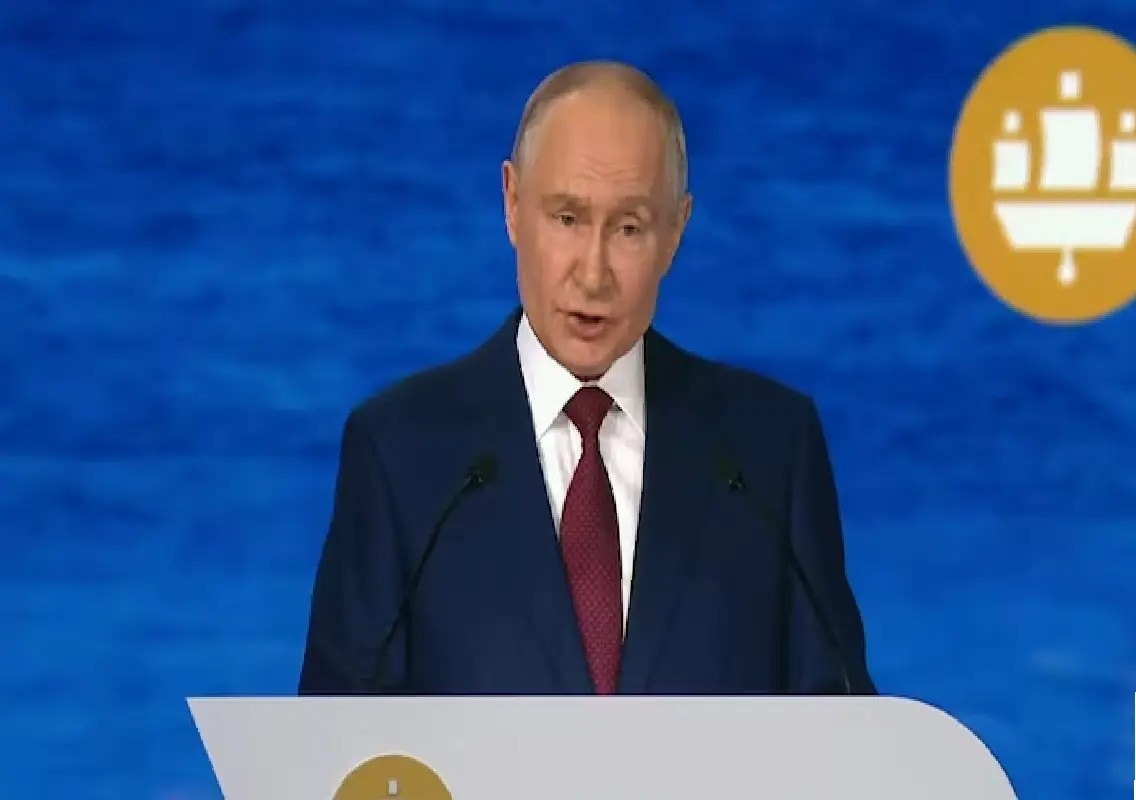


St Petersburg: Russian President Vladimir Putin has criticised the Western-dominated global financial system, claiming that countries around the world, particularly members of BRICS, are increasingly reducing their dependence on the US dollar and euro amid concerns over sanctions, asset freezes and financial restrictions.
Speaking at a plenary session of the Saint Petersburg International Economic Forum, Putin said the rise of BRICS nations and the Global South is reshaping international trade, finance and technology, accelerating the emergence of a multipolar world order.
Putin criticises Western policies
During his address, Putin argued that European policies and geopolitical strategies were weakening the continent’s economic influence and contributing to global instability.
He claimed that aggressive rhetoric and policy decisions by European leaders were leading to a gradual decline in Europe’s position within the global economy.
The Russian leader also alleged that Western powers were increasingly using financial systems and economic tools as instruments of geopolitical pressure.
Concerns over sanctions and asset freezes
Putin linked the growing move away from Western currencies to sanctions imposed on Russia following the conflict in Ukraine.
According to him, the freezing of Russian international reserves and restrictions on access to financial infrastructure have damaged confidence in traditional reserve currencies.
He argued that many countries now fear that access to assets denominated in US dollars or euros could be restricted during geopolitical disputes.
As a result, governments and businesses are exploring alternative payment mechanisms and financial arrangements.
Growing use of national currencies
The Russian President said countries are increasingly settling trade transactions in their own national currencies rather than relying on the dollar or euro.
He highlighted the growing use of alternative payment systems, digital financial assets and central bank digital currencies as examples of this trend.
Putin stated that a majority of Russia’s trade with key partners is now conducted in national currencies, with the Russian ruble accounting for a significant share of export settlements.
He described this shift as part of a broader transformation in the global financial landscape.
BRICS gaining economic influence
Putin emphasised the expanding economic weight of BRICS nations, portraying the bloc as a major driver of future global growth.
The grouping currently includes Brazil, Russia, India, China, South Africa and several recently admitted members.
According to Putin, BRICS economies have contributed a larger share of global economic growth than the Group of Seven in recent years.
He claimed that the economic gap between BRICS and G7 nations continues to widen as emerging economies record stronger growth rates.
Trade routes shifting east and south
Putin argued that the centre of global trade is gradually moving towards Asia, the Middle East, Africa and other emerging regions.
He pointed to infrastructure and connectivity projects such as the North-South Transport Corridor, Arctic shipping routes and expanding trade links through Central Asia and the Caspian region.
According to him, these initiatives are helping create alternative trade and logistics networks that reduce dependence on traditional Western-controlled routes.
The Russian President said this transformation reflects broader changes in the global economy and international power structures.
Criticism of global trade institutions
Putin also accused Western countries of selectively supporting international trade rules when they aligned with their interests.
Referring to the World Trade Organization, he argued that confidence in global institutions has weakened due to the increasing use of unilateral sanctions and trade restrictions.
He said a lack of trust in established institutions is encouraging countries to pursue bilateral and regional trade arrangements instead.
According to Putin, this trend is contributing to the development of alternative economic frameworks outside traditional Western influence.
Multipolar order taking shape
The Russian leader maintained that the global economy is undergoing a structural transformation rather than a temporary cycle of change.
He argued that the growing influence of BRICS nations, increased use of national currencies and development of alternative financial systems are key indicators of a multipolar international order.
While Western countries continue to defend sanctions as a legitimate foreign policy tool, Russia maintains that such measures are accelerating efforts by many nations to diversify trade, finance and payment systems.
The debate over the future role of the US dollar, global financial institutions and emerging economic blocs is expected to remain a central theme in international economic discussions in the coming years.