







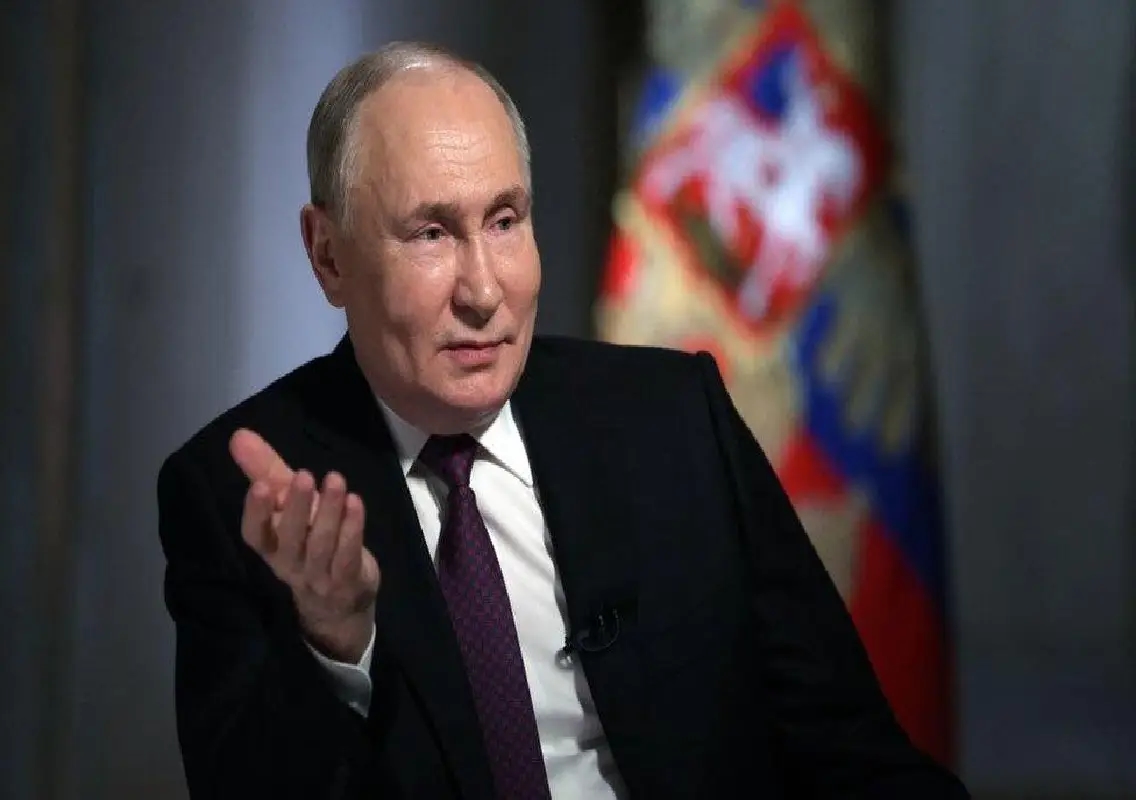


President Vladimir Putin on Sunday declared that strengthening Russia’s nuclear forces is now an “absolute priority”, days after the expiry of the last remaining nuclear arms control treaty between Moscow and Washington.
In a video message marking Defender of the Fatherland Day, Putin said the development of Russia’s nuclear triad — comprising land-based intercontinental ballistic missiles, submarine-launched ballistic missiles and strategic bombers — remains central to guaranteeing national security and maintaining global strategic balance.
“The development of the nuclear triad, which guarantees Russia’s security and ensures effective strategic deterrence and a balance of forces in the world, remains an absolute priority,” Putin said.
Treaty expiry reshapes nuclear landscape
Putin’s remarks come after the expiration of the New START agreement between Russia and the United States earlier this month. The treaty had placed limits on the number of deployed strategic nuclear warheads and delivery systems and allowed for mutual inspections.
With the expiry of New START, Moscow and Washington — the world’s two largest nuclear powers — are no longer bound by any active bilateral nuclear arms control pact for the first time in decades. The development marks a significant shift in global arms control architecture that had been in place, in various forms, since the Cold War.
Despite this, Russian authorities have indicated that they would continue to take what they describe as a “responsible” approach to strategic nuclear capability and would adhere to previously agreed limits on their arsenal, even in the absence of a formal treaty framework.
Military focus amid Ukraine war
Putin’s address came just two days before the fourth anniversary of Russia’s military offensive in Ukraine, launched in February 2022. The conflict has resulted in heavy casualties on both sides, widespread destruction across Ukrainian cities and the displacement of millions of civilians.
Referring indirectly to the ongoing conflict, Putin vowed to continue strengthening Russia’s armed forces and navy, drawing on what he described as combat experience gained over nearly four years of fighting.
He said all branches of the armed forces would be enhanced, including improvements in “combat readiness, mobility and the ability to operate in all conditions, even the most difficult”.
Defender of the Fatherland Day, observed annually on February 23, is a public holiday in Russia traditionally associated with honouring military personnel and veterans. It is often marked by patriotic ceremonies and messages emphasising national defence and sovereignty.
Global implications
The end of New START has raised concerns among arms control experts about the potential for a renewed nuclear arms race, particularly at a time of heightened geopolitical tensions between Russia and the West.
The treaty, signed in 2010 and extended in 2021, capped deployed strategic nuclear warheads at 1,550 for each side and limited the number of delivery systems such as missiles and heavy bombers. It also provided mechanisms for verification, including on-site inspections and data exchanges.
Without such a framework, transparency between the two powers could diminish, increasing mistrust and strategic uncertainty.
Putin’s emphasis on the nuclear triad underscores Russia’s intention to maintain parity with the United States in strategic deterrence. Moscow has in recent years unveiled new weapons systems, including hypersonic missiles and advanced intercontinental ballistic missiles, as part of its broader military modernisation programme.
At the same time, Russian officials have repeatedly stated that nuclear weapons are intended as a deterrent and not for offensive use, although rhetoric around nuclear preparedness has intensified since the beginning of the Ukraine conflict.
A shifting arms control era
The collapse of successive arms control agreements over the past decade has already altered the global security environment. Prior treaties such as the Intermediate-Range Nuclear Forces (INF) Treaty were also terminated, reducing the number of binding constraints on nuclear arsenals.
With no active bilateral arms control agreement currently in force between Moscow and Washington, future negotiations — if any — would likely take place against the backdrop of strained diplomatic ties and the ongoing war in Ukraine.
For now, Putin’s message signals a continued focus on strategic deterrence as a cornerstone of Russia’s security policy. As the conflict in Ukraine enters its fifth year and global tensions persist, the absence of a formal nuclear arms control framework adds a new layer of complexity to an already volatile international landscape.