







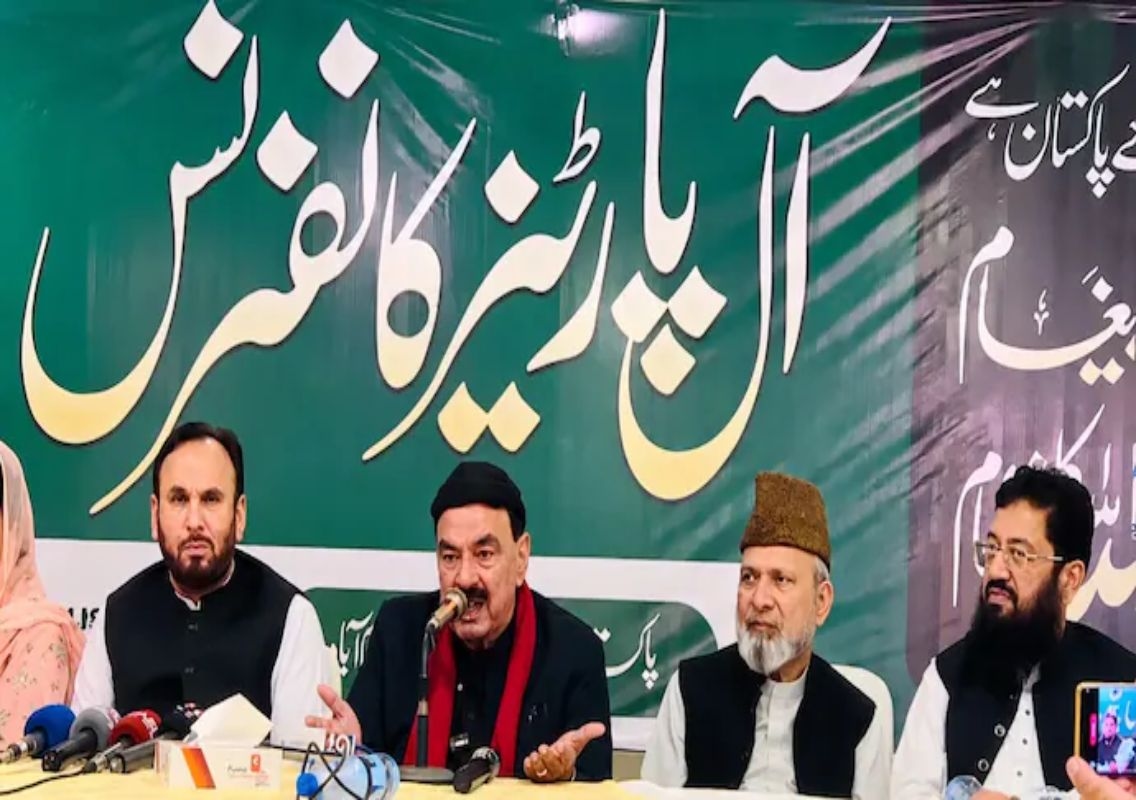


Islamabad: Former Pakistan Interior Minister Sheikh Rasheed Ahmed has triggered controversy after appearing at a public event alongside figures identified by India Today as senior members of the Lashkar-e-Taiba (LeT), where he praised jailed terrorist Hafiz Saeed and made inflammatory remarks targeting India.
A video from the event shows Rasheed sharing the stage with Khalid Masood Sandhu, identified as a senior LeT commander and president of the Pakistan Markazi Muslim League (PMML), and Qari Muhammad Yaqoob Sheikh, described as a member of the terror group’s central advisory committee.
The appearance has drawn attention because Rasheed previously served as Pakistan’s Interior Minister under former Prime Minister Imran Khan from 2020 to 2022. He is also the founder and leader of the Awami Muslim League.
Sheikh Rasheed praises Hafiz Saeed
During his address at the event, Rasheed openly expressed support for Hafiz Saeed, the founder of Lashkar-e-Taiba and a United Nations-designated terrorist.
According to the video cited by India Today, Rasheed said, “Main Hafiz sahab ka ghulam hu”, which translates to “I am a slave of Hafiz Saeed”. He also claimed that Saeed’s phone number had appeared on his phone while Rasheed was in the United States and that he was subsequently expelled from the country.
Rasheed went on to state that he and those at the gathering stood with Pakistan and Hafiz Saeed. His comments have attracted particular scrutiny because of Saeed’s longstanding association with Lashkar-e-Taiba and the group’s role in terrorism.
The former minister’s appearance alongside individuals identified as LeT figures adds another dimension to the controversy. It also highlights the continuing political and public presence of individuals associated with organisations that have been designated as terrorist groups internationally.
Former minister makes threats against India
Rasheed’s remarks were not limited to praising Saeed. He also made inflammatory comments directed at India.
During his speech, he said that Allah would destroy India if it “even looks towards Pakistan”. He further used religious imagery to make a threat about India’s future, saying that no birds would chirp in India and no bells would ring in a temple.
Such statements have the potential to further inflame already sensitive relations between India and Pakistan, particularly at a time when security concerns and cross-border terrorism remain major issues in bilateral relations.
The remarks were made publicly and were captured on video, allowing them to circulate beyond the event itself. The presence of political figures and individuals identified as members of a banned terrorist organisation at the same gathering has also raised questions about the political environment surrounding such events in Pakistan.
Rasheed’s comments should be viewed as statements made by an individual political figure and not as an official declaration of Pakistan’s government policy.
Who is Sheikh Rasheed Ahmed?
Sheikh Rasheed Ahmed is a veteran Pakistani politician who has held several ministerial positions.
He served as Pakistan’s Interior Minister during the Imran Khan government between 2020 and 2022. He is currently associated with the Awami Muslim League, which he founded and leads.
His political career has included outspoken positions on issues involving India and Pakistan’s security and foreign policy. His latest appearance is therefore likely to attract considerable attention because of his previous position in Pakistan’s government.
However, he is no longer Pakistan’s Interior Minister. His remarks at the event consequently do not represent an official statement from Pakistan’s current Interior Ministry or government unless separately endorsed by the authorities.
Why Hafiz Saeed remains a controversial figure
Hafiz Saeed is one of the most prominent names associated with Lashkar-e-Taiba, an organisation designated as a terrorist group by several countries and international bodies.
LeT has been associated with numerous attacks and militant activities, while Saeed has long been a major target of international counterterrorism efforts.
The United States has offered a substantial reward for information leading to Saeed’s arrest and conviction, while the United Nations has listed him under its sanctions regime.
Saeed was convicted by Pakistani authorities in terrorism-financing cases and has remained in Pakistani custody. His name is also closely associated with the 2008 Mumbai terror attacks, in which 166 people were killed.
Against that background, public praise for Saeed by a former Pakistani Interior Minister is particularly significant. It can generate concerns over political rhetoric surrounding militant organisations and the degree to which their ideological influence continues to feature in public discourse.
LeT figures seen alongside Rasheed
The video identified by India Today shows Rasheed seated between two individuals described as senior figures associated with Lashkar-e-Taiba.
One is Khalid Masood Sandhu, identified as a senior LeT commander and president of the Pakistan Markazi Muslim League. The other is Qari Muhammad Yaqoob Sheikh, identified as a member of the terror group’s central advisory committee.
The Pakistan Markazi Muslim League has previously been described as having links to individuals associated with Lashkar-e-Taiba. Its political activities have also attracted scrutiny over alleged connections to the militant organisation.
The presence of such figures at a political or public gathering is notable because Pakistan has repeatedly faced international pressure to take action against terrorist organisations and their financing and political networks.
However, the identities and affiliations cited in reports should be distinguished from any broader claim that every person attending or appearing at the event is necessarily a member of a terrorist organisation.
India-Pakistan tensions remain sensitive
The latest controversy comes against the backdrop of a long and difficult relationship between India and Pakistan.
Relations between the two nuclear-armed neighbours have repeatedly been affected by terrorism, military confrontations and disputes over Jammu and Kashmir. Statements threatening India from Pakistani political figures can therefore attract considerable attention, particularly when they are accompanied by references to individuals associated with militant organisations.
For India, Hafiz Saeed remains an especially sensitive name because of his alleged role in the Mumbai attacks and his association with Lashkar-e-Taiba.
For Pakistan, public appearances involving political figures and individuals linked to banned militant organisations can also raise questions about efforts to curb extremist networks.
What happens next?
The immediate significance of Rasheed’s remarks will depend partly on how Pakistan’s political and security establishment responds.
India has not, in the material cited here, issued a response to Rasheed’s latest comments. Pakistan’s government has also not been reported as endorsing his statements.
The video nevertheless provides a clear record of the former minister’s remarks and his appearance alongside individuals identified as LeT figures.
The episode is likely to add to scrutiny of the relationship between Pakistani politics, militant networks and public rhetoric concerning India. It also demonstrates why statements made by former senior government officials can continue to carry political significance even after they leave office.
Conclusion
Sheikh Rasheed’s appearance alongside individuals identified as Lashkar-e-Taiba figures, his praise for Hafiz Saeed and his inflammatory remarks against India have created a fresh controversy in Pakistan. While his comments do not constitute official government policy, his history as Pakistan’s former Interior Minister gives the episode added significance.
The incident is likely to be closely watched in India, particularly because of the references to Hafiz Saeed and the continuing sensitivity surrounding Lashkar-e-Taiba’s alleged role in terrorism against India.