









US President Donald Trump has announced plans for the US Navy to build a new “Trump-class” battleship, a move the White House says is aimed at modernising a fleet plagued by years of cost overruns, delays and shrinking ship numbers, even as strategic competition with China intensifies.
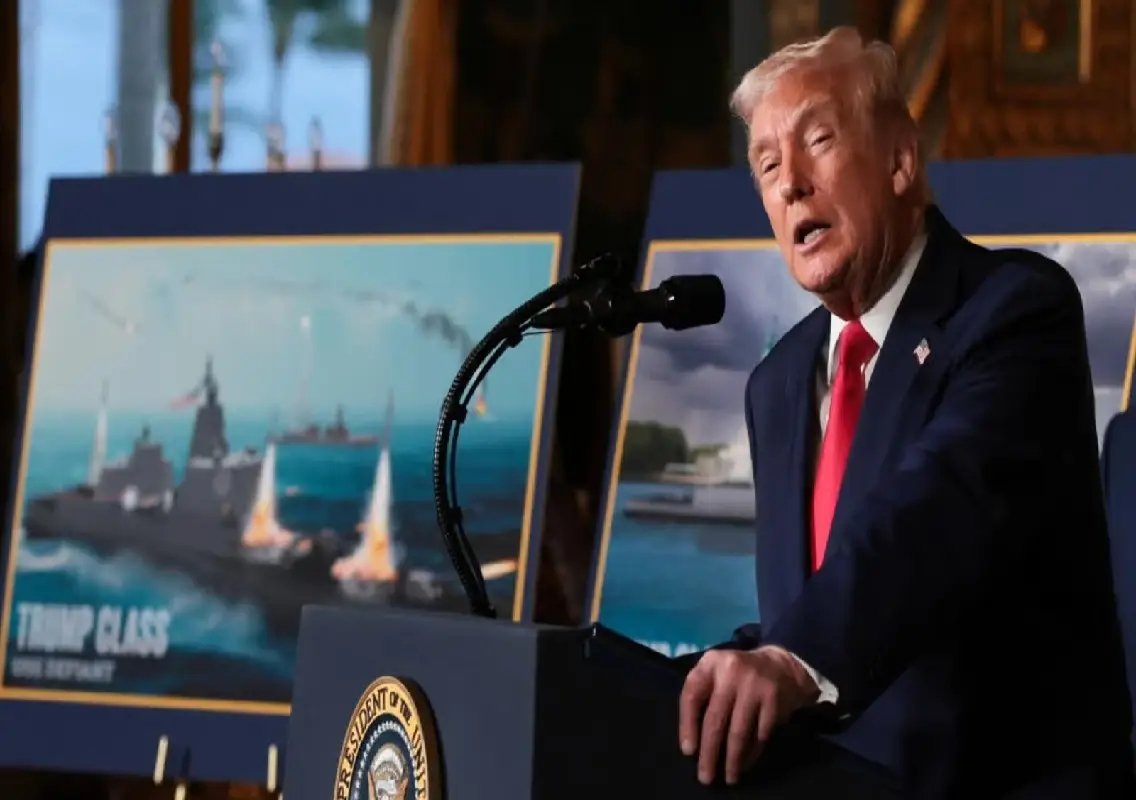
Speaking after unveiling what he called the Navy’s new “Golden Fleet” initiative, Trump said the proposed Trump-class battleship would mark a dramatic reversal from what he described as decades of decline in American naval shipbuilding. The announcement was made at an event attended by senior Navy officials and political allies, where promotional material showcased a futuristic warship named the USS Defiant.
According to the White House, the Trump-class battleship programme is intended to restore US shipbuilding capacity while addressing gaps in surface combatant strength. Trump said the Navy would initially plan to build two ships, with an eventual goal of as many as 25 vessels, depending on funding and industrial capacity.
A symbolic and strategic announcement
At the event, posters displayed artist impressions of the USS Defiant slicing through rough seas, equipped with advanced weaponry including what appeared to be a directed-energy laser system. One image showed the ship sailing past the Statue of Liberty, while another featured Trump raising his fist in a pose reminiscent of the moment after he survived an assassination attempt in 2024.
“Some of them have gotten old and tired and obsolete, and we’re going to go the exact opposite direction,” Trump said, referring to existing naval platforms. He added that the US Navy would lead the design process “alongside me”, noting his personal interest in the aesthetics of the ships.
While largely symbolic at this stage, the announcement underscores Trump’s desire to directly associate himself with major defence platforms, following earlier references to the F-47 stealth aircraft, named after his position as the 47th President of the United States.
Golden Fleet and the push against China
The proposed Trump-class battleships form part of Trump’s broader “Golden Fleet” initiative, which seeks to revive US shipbuilding as a strategic priority. The administration argues that America’s naval industrial base has fallen far behind China, which now accounts for around 53% of global shipbuilding output.
By contrast, the US builds just 0.1% of the world’s ships, according to recent assessments by the Center for Strategic and International Studies. Trump administration officials say this imbalance poses long-term risks to national security, particularly in the Indo-Pacific region.
To address this, Trump earlier announced the creation of a new Office of Shipbuilding, alongside proposals for tax incentives and financial support aimed at encouraging companies to build ships in the US. The Trump-class programme is being positioned as a flagship project under this renewed industrial push.
Questions over feasibility and timelines
Despite the ambitious rhetoric, defence analysts caution that production of a new battleship class could be years, if not decades, away. The US has not built a battleship since the 1940s, having instead focused on aircraft carriers, destroyers and missile-equipped surface combatants.
Trump’s own record on naval procurement has also drawn scrutiny. During his previous term, an attempt to launch a new frigate programme ran significantly over budget and suffered repeated delays. Originally planned at 20 vessels, the programme was eventually scaled back after costs ballooned and timelines slipped.
Similar concerns surround the Trump-class proposal, particularly given the complexity of modern warship design, workforce shortages and rising material costs. Experts note that restarting battleship construction would require massive investment in infrastructure and skills that no longer exist at scale.
Navy leadership backs the concept
Despite the uncertainties, senior Navy officials publicly endorsed the proposal. Navy Secretary John Phelan said the Trump-class battleship would meet a “desperate need” within the service.
“The future Trump-class battleship, USS Defiant, will be the largest, deadliest, most versatile and best-looking warship anywhere on the world’s oceans,” Phelan said. He added that the programme now has a formal requirement within the Navy’s long-term planning framework.
Alongside the battleship announcement, the Navy also confirmed it is pursuing a new frigate, the FF(X), based on the Legend-class cutter. The ship will be built by Newport News-based HII and is intended to help address shortages in smaller surface combatants, with the Navy currently operating at roughly one-third of its assessed requirement.
Replacing ageing destroyers
According to officials, the Trump-class battleship is envisioned as a long-term replacement for Arleigh Burke-class destroyers, many of which still have nearly four decades of service life remaining. These destroyers are equipped with the Aegis Combat System, which provides advanced missile defence capabilities.
Analysts say it remains unclear how a large battleship would fit into modern naval warfare, which increasingly relies on submarines, unmanned systems and long-range precision missiles rather than heavily armoured surface ships.
Conclusion
The announcement of the Trump-class battleship reflects both Donald Trump’s personal branding style and his administration’s determination to revive US shipbuilding amid rising global competition. While the proposal has generated attention and enthusiasm within parts of the Navy, significant questions remain over cost, timelines and strategic relevance. Whether the Trump-class becomes a transformative platform or remains a bold concept will depend on sustained funding, industrial capacity and political will in the years ahead.