







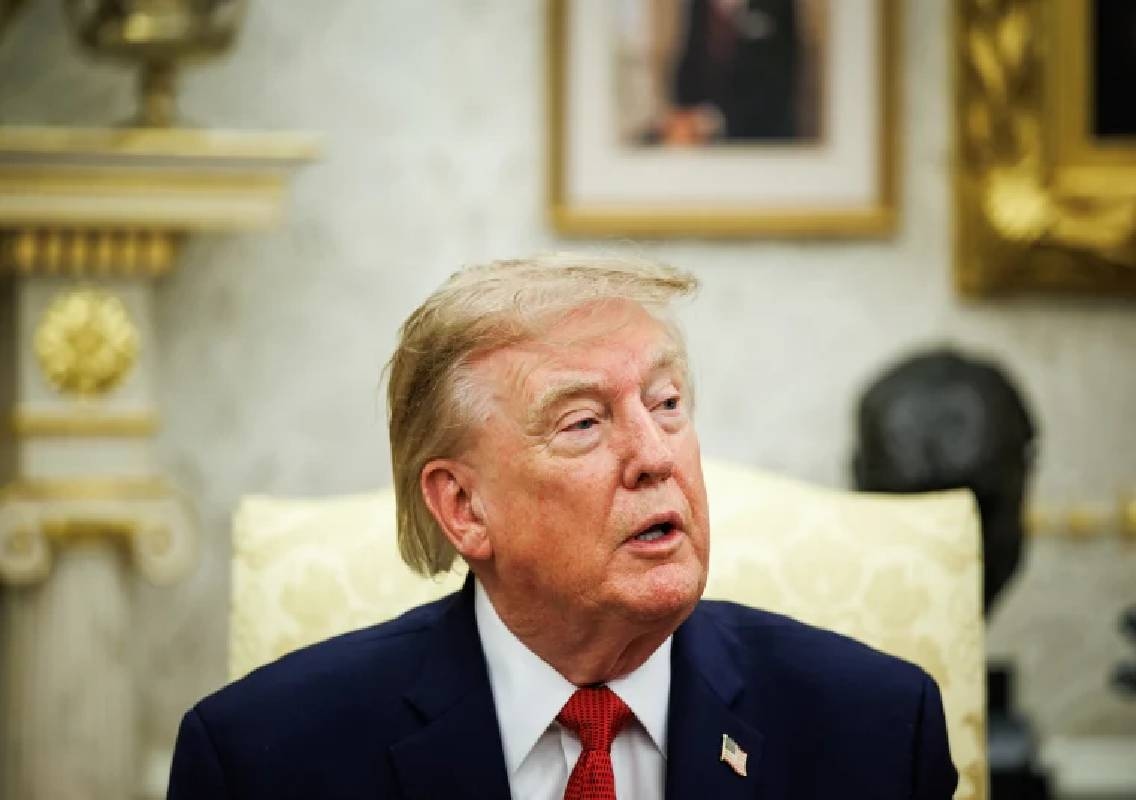


Washington: US President Donald Trump has cited India’s electoral system and voter identification requirements while renewing his push for stricter voting rules in the United States. Trump invoked India’s recent general election as he urged Congress to pass the Safeguard American Voter Eligibility (SAVE) America Act, which seeks nationwide voter ID requirements and proof of citizenship for voter registration.
Trump made the comments in a post on Truth Social, referring to an alleged recent interaction between India’s Chief Election Commissioner Gyanesh Kumar and the US administration. He said Kumar had questioned how elections could be conducted in the US without mandatory photo identification.
Trump highlights India’s voter identification system
Trump said India’s most recent general election involved around 646 million voters and claimed that less than 1% voted by mail.
He also pointed to India’s requirement for voters to carry a valid photo identity document as an example of how a large democracy manages voter identification.
Trump wrote that the Indian poll chief had asked the US administration how elections could be conducted without a valid photo ID. He used the observation to strengthen his argument that the US should introduce stricter identification requirements. (NDTV)
The comments effectively brought India’s election system into an ongoing American political debate over voter identification, citizenship verification and postal voting.
What is the SAVE America Act?
Trump’s remarks were aimed at building support for the Safeguard American Voter Eligibility (SAVE) America Act.
The proposed legislation would introduce stricter requirements for federal elections in the US. Among its key provisions are requirements for voters to provide proof of US citizenship when registering and a nationwide voter identification requirement.
The legislation would also place significant restrictions on voting by mail. Trump and supporters of the proposal argue that such measures would strengthen election security and reduce opportunities for electoral fraud.
The proposal, however, remains part of a politically contentious debate in the United States, with disagreements over its potential impact on voters and election administration.
Why Trump brought India into the debate
India conducts elections on a vastly larger scale than most democracies.
The 2024 Lok Sabha election involved hundreds of millions of voters across the country, with the Election Commission managing polling stations, electoral rolls and voter identification across diverse geographical regions.
Trump’s reference to India was therefore intended to demonstrate that mandatory voter identification can be implemented even in a country with an enormous electorate.
His argument is essentially that if India can manage identification requirements across hundreds of millions of voters, the US should also be able to establish a nationwide system.
India uses the Electors Photo Identity Card
The Electors Photo Identity Card (EPIC) is a key voter identification document issued under India’s election system.
At polling stations, voters can be asked to produce the EPIC or another identification document approved by the Election Commission. The voter must also be registered on the electoral roll.
This distinction is important: having an identity document alone does not make someone eligible to vote. Eligibility also depends on being registered as an elector and meeting the legal requirements to vote.
The Election Commission maintains electoral rolls and issues instructions concerning acceptable identification documents for polling.
Trump’s claim about Gyanesh Kumar
Trump specifically attributed the question about US voter identification to Chief Election Commissioner Gyanesh Kumar.
According to Trump’s account, Kumar questioned how American elections could take place without voters presenting valid photo identification.
However, the exact details of the exchange described by Trump have not been independently established through a publicly available record. Some reports have noted the absence of a confirmed public record documenting the specific conversation in the manner described by the US president.
That makes it important to distinguish between Trump’s account of the interaction and independently verified details.
India’s low use of postal voting cited
Another aspect Trump highlighted was India’s use of postal ballots.
He said less than 1% of voters in India’s latest general election voted by mail.
India does have postal-ballot provisions, but they apply primarily to specific categories of voters who meet eligibility requirements under election rules. The country’s electoral system also relies heavily on in-person voting at polling stations.
Trump used this difference to argue for tighter restrictions on postal voting in the United States.
US voting rules differ from India
The comparison between the two countries comes with important differences.
India has a nationally administered election framework overseen by the Election Commission, while US elections are highly decentralised, with states playing a major role in administering elections.
Rules concerning voter registration, identification and voting methods can therefore vary considerably across US states.
The absence of one uniform national voter-ID requirement has been a longstanding point of political debate in America.
Trump wants the federal government to establish stricter nationwide standards.
Election security becomes central issue
Trump has repeatedly made election integrity a major political issue.
His latest comments again connect voter identification with concerns about electoral fraud.
Supporters of stricter ID rules argue that requiring identification can strengthen confidence in elections and make certain forms of impersonation more difficult.
Opponents have argued that strict identification requirements can create additional barriers for eligible voters who may not possess particular documents or find it difficult to obtain them.
The debate therefore extends beyond technology or administration into questions about voting access.
India becomes an example in US political debate
Trump’s remarks are notable because India is increasingly being used as a reference point in discussions about election administration.
The country’s ability to conduct elections involving hundreds of millions of people provides a striking example of large-scale electoral management.
For Trump, India’s voter identification system offers a model that he believes the US should consider.
The comparison also places India’s Election Commission and its election infrastructure under an unusual international spotlight.
US Ambassador also backs the argument
US Ambassador to India Sergio Gor has also highlighted India’s voter ID system while supporting the push for the proposed legislation.
The comments reinforce the Trump administration’s broader argument that voter identification and citizenship verification should play a greater role in US federal elections.
The administration has previously pointed to other countries’ election systems while making the case for stronger American election safeguards.
Political debate likely to continue
The SAVE America Act faces political divisions in Washington.
While Trump has made the legislation a priority, its provisions have generated disagreement among lawmakers over both election security and voting access.
The debate is likely to remain politically significant as the US moves towards its next major electoral cycle.
For Trump’s administration, voter ID is part of a broader effort to change how federal elections are conducted and how voter eligibility is verified.
India’s electoral system gets international attention
Trump’s comments represent an unusual form of international recognition for India’s voter identification framework.
The world’s largest electorate operates a system in which voter identification, electoral rolls and polling-station procedures are integrated into a massive nationwide election exercise.
At the same time, comparisons between the two countries need to account for their different constitutional structures, election administration models and voting practices.
India’s system cannot simply be transferred to the US without addressing those differences.
Conclusion
Donald Trump has cited India’s voter identification system while pushing for stricter election rules in the United States. Referring to India’s recent general election, he highlighted the country’s huge electorate, low use of postal ballots and requirement for voters to present valid photo identification.
Trump used the comparison to renew his call for passage of the SAVE America Act, which seeks proof of citizenship for voter registration, nationwide voter identification requirements and tighter restrictions on voting by mail.
While India’s election system has become an example in Trump’s argument, the two countries operate under significantly different electoral structures. The precise details of the conversation Trump attributed to Chief Election Commissioner Gyanesh Kumar also remain unclear from publicly available records.
The episode nevertheless highlights how India’s experience of managing elections involving hundreds of millions of voters is now featuring prominently in the American debate over voter ID and election security.