







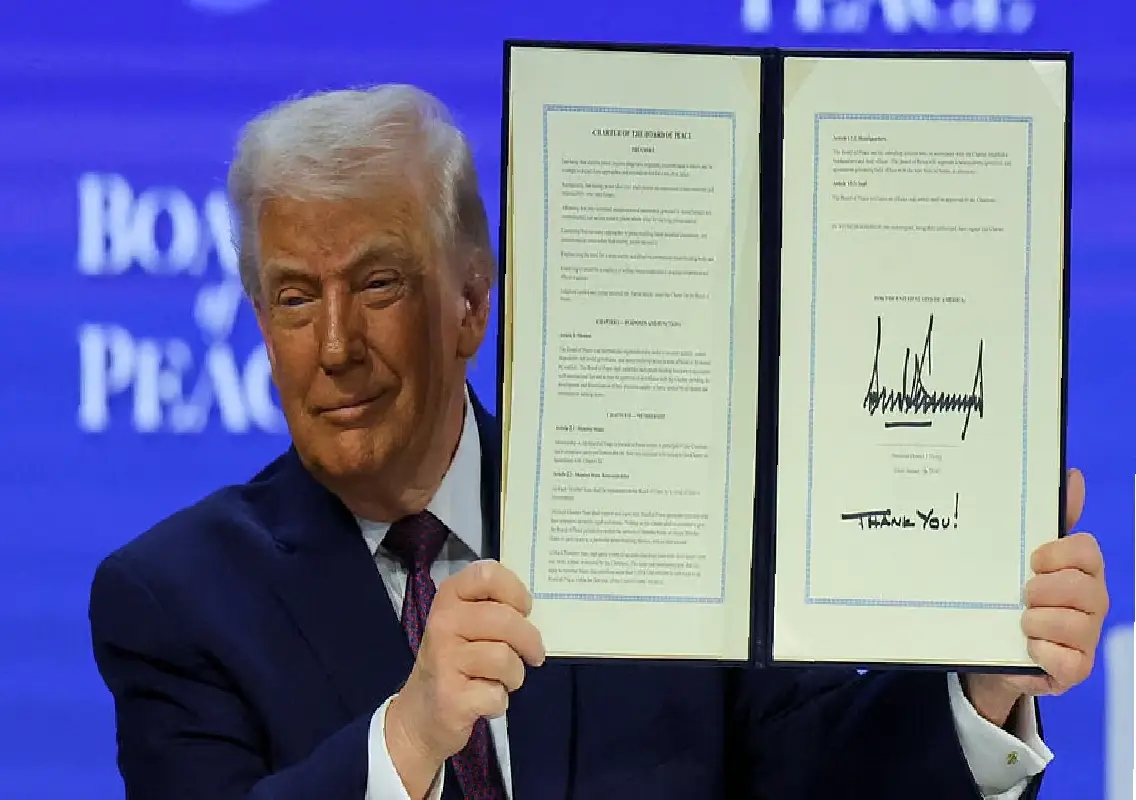


US President Donald Trump on Thursday formally launched his much-anticipated “Board of Peace”, an international body that was initially conceived to help end the Gaza war but is now being projected by the White House as a broader global peace mechanism. The move has triggered mixed reactions worldwide, with several countries signing on, while others, particularly in Europe, have expressed concern that the new body could rival or undermine the role of the United Nations.
The announcement and signing ceremony took place on the sidelines of the World Economic Forum in Davos, where Trump described the Board of Peace as “one of the most consequential bodies ever created” and claimed that “every country wants to be a part of it”.
Countries sign on, funding plan unveiled
According to US officials, countries including Pakistan, Azerbaijan and the United Arab Emirates formally signed the agreement establishing the Board of Peace on Thursday. Trump said that permanent members would be required to contribute 1 billion dollars each to fund the body’s activities, positioning it as a well-resourced alternative platform for conflict resolution and post-war reconstruction.
“Today the world is richer, safer, and much more peaceful than it was just one year ago,” Trump said at the event. “We put out all those fires.”
In remarks that drew particular attention in South Asia, Trump claimed credit for defusing tensions between India and Pakistan. “We were very happy to stop the war that had started with India and Pakistan, two nuclear nations. I was very honoured when the Prime Minister of Pakistan said President Trump saved 10 and maybe 20 million lives by getting that stopped just before bad things were going to happen,” he said.
India has not officially responded to these claims, and New Delhi is yet to take a call on the invitation extended by Trump to join the Board of Peace.
Gaza focus and UN linkage
The Board of Peace was originally proposed as part of Trump’s Gaza peace plan and was endorsed by a United Nations Security Council resolution in that limited context. However, Trump’s framing of the board as a wide-ranging international organisation has raised alarms among diplomats and multilateral institutions.
UN spokesperson Rolando Gomez clarified on Thursday that the United Nations’ engagement with the Board of Peace would be restricted strictly to the Gaza-related mandate outlined in the Security Council resolution. “UN engagement with the board would only be in that context,” he said, signalling the UN’s reluctance to endorse a parallel global peace architecture.
At the Davos ceremony, Trump reiterated that the board had secured commitments to ensure that Gaza would be demilitarised and “beautifully rebuilt” after the conflict. The reconstruction plan, he suggested, would be one of the board’s flagship initiatives.
Diverging global responses
The international response to the Board of Peace has been sharply divided. Russia, according to its state-run news agency TASS, has said it is ready to contribute 1 billion dollars to the board to support the Palestinian people. Moscow confirmed that it was studying the proposal after Trump said Russia would join.
In contrast, several major Western powers have declined to sign on, at least for now. France has opted out, while Britain said on Thursday that it would not be joining the board at present. China has not yet indicated whether it will participate, maintaining silence on Trump’s invitation.
European diplomats have privately expressed concern that the Board of Peace could weaken the authority of the United Nations by drawing resources, legitimacy and political attention away from existing multilateral frameworks. Critics argue that peace-building efforts risk becoming fragmented if parallel institutions compete rather than cooperate.
White House hails historic moment
The White House has dismissed such criticism, portraying the board as a complementary body rather than a competitor to the UN. At the signing ceremony, White House Press Secretary Karoline Leavitt declared the initiative operational.
“Congratulations President Trump, the charter is now in full force, and the Board of Peace is now an official international organisation,” she said.
US officials insist that the board will focus on rapid conflict mediation, post-war stabilisation and reconstruction, areas where they claim existing global institutions have often moved too slowly.
Conclusion
While President Trump has positioned the Board of Peace as a landmark achievement that will reshape global conflict resolution, its long-term impact remains uncertain. With key powers divided over its legitimacy and relationship with the United Nations, the new body’s success will depend on whether it can complement existing international mechanisms or whether fears of rivalry and duplication ultimately come true.