







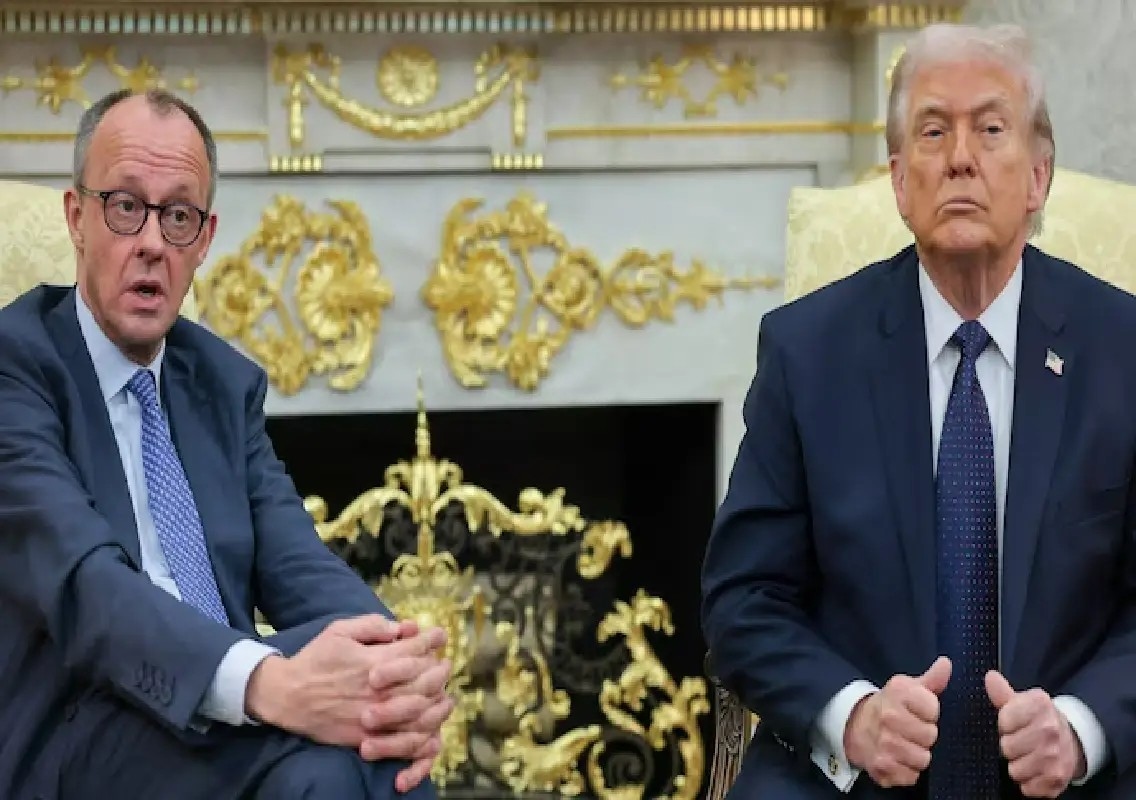


Washington: Donald Trump has intensified his criticism of Friedrich Merz, urging the German leader to focus on domestic issues and the Russia-Ukraine conflict instead of commenting on Washington’s approach to Iran.
The sharp remarks come amid a growing war of words between the two leaders over handling of Iran’s nuclear ambitions and broader geopolitical strategy.
Trump hits back over Iran comments
The US President took to his social media platform to accuse Merz of interfering in American foreign policy. Trump’s response followed remarks by the German Chancellor suggesting that the United States had been outmanoeuvred in negotiations with Tehran.
In a strongly worded statement, Trump said Merz should concentrate on resolving the Russia-Ukraine war and addressing internal challenges such as immigration and energy issues in Germany.
He also defended his administration’s stance on Iran, asserting that his efforts were aimed at eliminating the nuclear threat and making the world safer.
Dispute rooted in Iran policy differences
The disagreement escalated after Merz publicly questioned Washington’s strategy, describing it as ineffective and suggesting that Iranian negotiators had gained the upper hand.
Trump dismissed those claims, stating that Merz “doesn’t know what he’s talking about” and warning that a nuclear-armed Iran would pose a global threat.
The exchange highlights a widening divide between the two leaders on how to approach Iran, particularly in the context of ongoing tensions and diplomatic efforts.
Merz downplays tensions
Despite the public criticism, Merz sought to tone down the dispute, stating that his personal relationship with Trump remains intact.
He reiterated that his concerns were focused on the broader consequences of the conflict, including its economic impact on Europe. In particular, he pointed to disruptions in the Strait of Hormuz, which have affected global energy supplies and contributed to rising fuel prices.
Wider geopolitical implications
The disagreement comes at a time of heightened global tensions, with the Iran issue intersecting with ongoing conflicts and energy security concerns.
Rising fuel prices linked to instability in West Asia are also creating domestic political pressure in the United States, especially ahead of upcoming midterm elections.
Additionally, the dispute has revived discussions about the US military presence in Germany. Trump recently indicated that his administration is reviewing the possibility of reducing troop levels.
Germany hosts a significant number of US forces, including at key installations such as Ramstein, making it a central hub for American military operations in Europe.
Conclusion
The escalating rhetoric between Trump and Merz underscores growing transatlantic differences over foreign policy priorities. While both leaders have sought to maintain diplomatic ties, their public exchanges reflect deeper disagreements on Iran, security, and global strategy that could shape future relations between the US and Germany.