







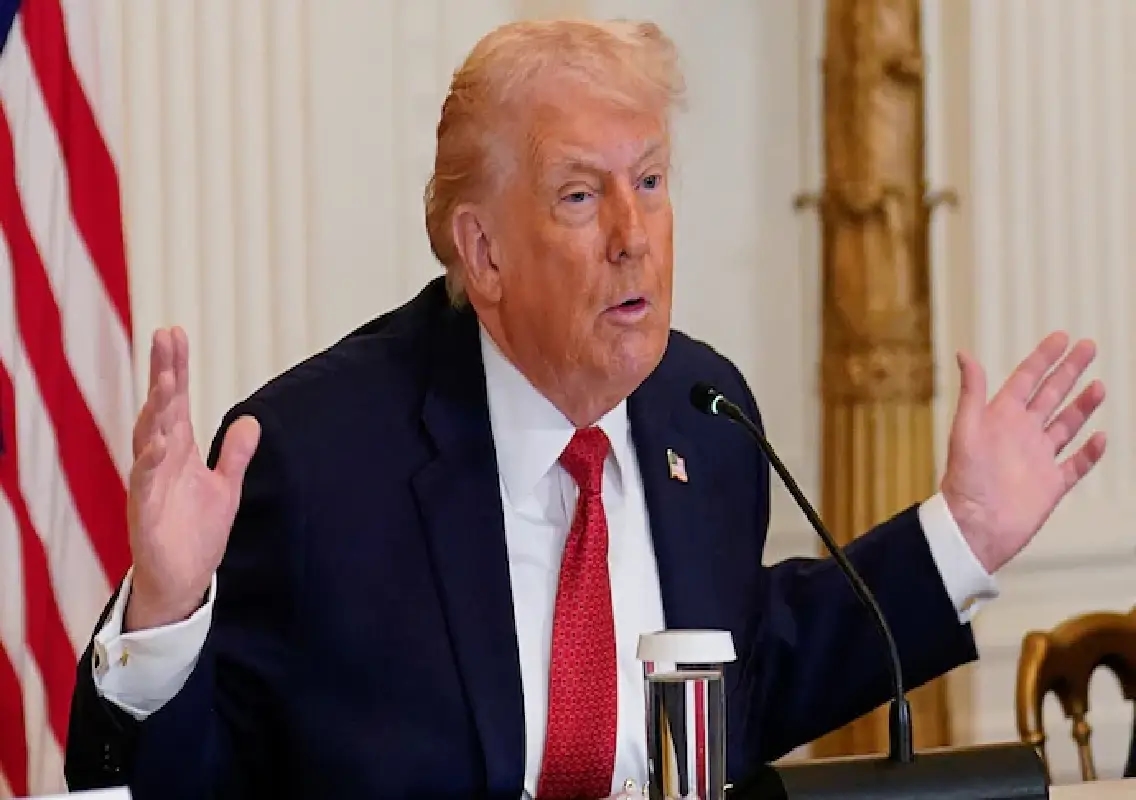


Washington: President Donald Trump on Friday warned that the United States could impose tariffs on countries that refuse to support his push for American control of Greenland, escalating tensions with European allies over the strategically critical Arctic island and raising concerns about the future of transatlantic relations.
Tariff threat as diplomatic pressure
Speaking at a White House health-related event, Trump said economic pressure could be used against countries opposing his Greenland proposal, framing the move as a matter of US national security. “I may put a tariff on countries if they don’t go along with Greenland, because we need Greenland for national security,” he said.
The warning marks a significant escalation in rhetoric and policy, as Trump has increasingly relied on tariffs and sanctions as instruments of foreign policy. During his presidency, the US has imposed punitive measures on countries purchasing Russian oil and enforced sweeping sanctions on nations involved in trade with Iran. The Greenland threat signals a willingness to extend similar pressure to long-standing allies.
Greenland, an autonomous territory within the Kingdom of Denmark, has long been of strategic interest to Washington because of its location in the Arctic, proximity to key North Atlantic shipping routes, and its vast reserves of rare earth minerals. The island also hosts a major US military base that plays a crucial role in missile defence and early-warning systems.
Talks with Denmark fail to bridge differences
Senior officials from the United States, Denmark and Greenland recently held face-to-face talks in Washington to discuss Trump’s ambitions. However, Danish Foreign Minister Lars Lokke Rasmussen said a “fundamental disagreement” persisted after meetings with US Vice President JD Vance and Secretary of State Marco Rubio.
Rasmussen said Denmark had not expected the discussions to shift Washington’s stance and reaffirmed that Greenland was not for sale. Despite the sharp differences, all three sides agreed to establish a high-level working group aimed at exploring limited areas of compromise.
According to Rasmussen, the group would focus on addressing US security concerns in the Arctic while respecting Denmark’s “red lines”, including sovereignty and Greenlandic self-governance. He stressed that Denmark and the US remain allies within NATO, even as disagreements deepen.
Military signals in the Arctic
As diplomatic talks stalled, Denmark announced an increase in its military presence in Greenland, a move mirrored by several European allies. France, Germany, Norway and Sweden said they would send small contingents of troops in what officials described as a symbolic but deliberate show of solidarity with Copenhagen.
Britain and Germany also confirmed limited deployments tied to Arctic security exercises. Danish Defence Minister Troels Lund Poulsen said the intention was to work towards a more permanent military presence and expand joint drills with allies in the coming weeks.
These developments reflect growing concern among Western nations about intensifying strategic competition in the Arctic. Melting ice has opened new shipping routes and increased access to natural resources, making the region a focal point of geopolitical rivalry.
NATO and wider geopolitical concerns
Italian Prime Minister Giorgia Meloni urged NATO to develop a “coordinated presence” in the Arctic to manage tensions and counter what she described as interference by other actors. European leaders have largely argued that Arctic security should be addressed collectively through NATO frameworks rather than unilateral actions.
Trump, however, has repeatedly argued that direct US control over Greenland is essential to prevent Russia or China from gaining a foothold on the mineral-rich island. Danish and Greenlandic representatives rejected this claim during the latest round of talks, stating that existing NATO arrangements and bilateral cooperation already address security concerns.
Russia has denied posing any threat to Greenland, while China has accused Washington of using external actors as a pretext to advance its own strategic and economic interests in the Arctic.
Strain on transatlantic relations
Analysts warn that the combination of tariff threats, stalled diplomacy and symbolic troop deployments risks further straining relations between the US and its European allies. While Denmark and other NATO members have sought to keep discussions within alliance structures, Trump’s rhetoric has fuelled uncertainty about Washington’s long-term approach.
Trade experts also caution that imposing tariffs on allied countries over a territorial dispute could have wider economic consequences, potentially triggering retaliatory measures and undermining global trade stability.
At the same time, Greenland’s own leaders have reiterated their opposition to any transfer of control, emphasising the island’s right to self-determination and its desire to balance economic development with environmental protection.
Conclusion
Trump’s latest tariff warning underscores his administration’s willingness to use economic leverage to pursue strategic goals, even at the risk of alienating close allies. As diplomatic talks continue and military posturing increases in the Arctic, Greenland has emerged as a new flashpoint in global geopolitics. Whether the standoff leads to compromise within NATO or further confrontation remains uncertain, but the episode has already highlighted deepening fault lines in transatlantic relations.