







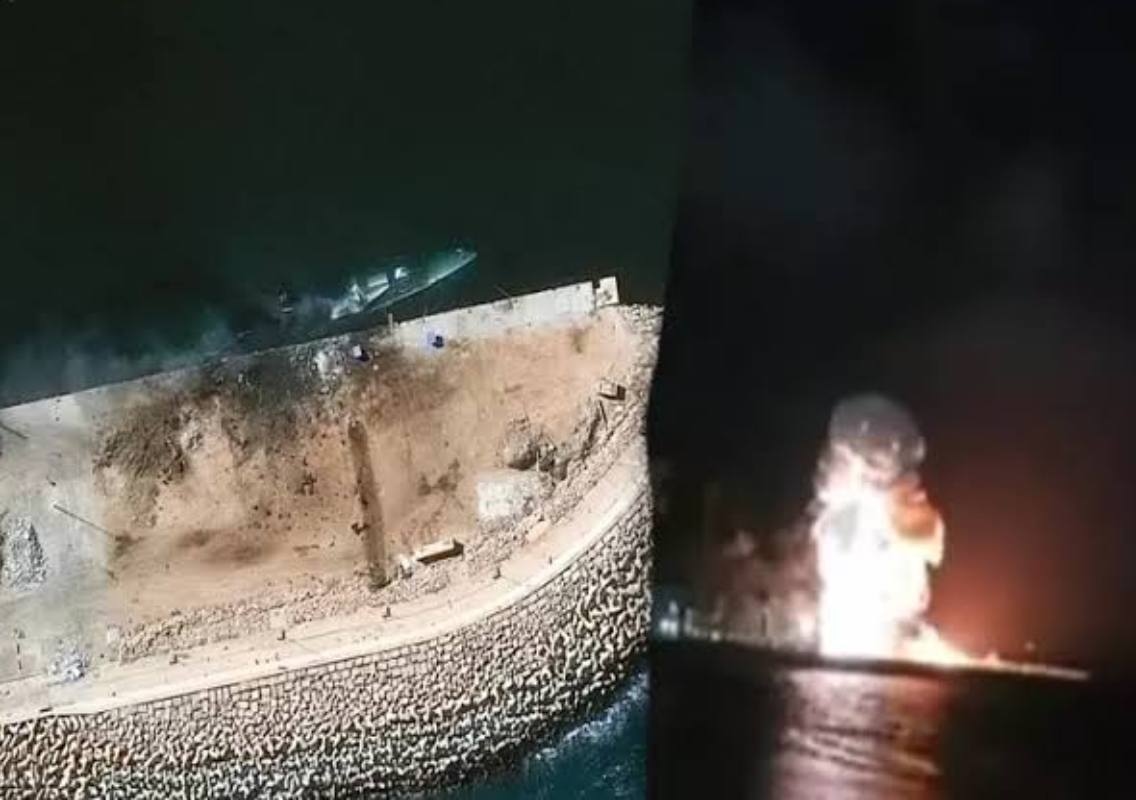


Kyiv: Ukrainian President Volodymyr Zelenskyy on Monday confirmed that Ukrainian forces sank a Russian Navy warship in a drone strike at the port of Benghazi in eastern Libya, extending the conflict between Moscow and Kyiv far beyond the traditional battlefield.
The Russian corvette Merkury was struck on Sunday, November 22, while docked at the Libyan port. The attack reportedly triggered explosions and a fire, with satellite images later showing the vessel had capsized. Zelenskyy said the operation was carried out using Ukrainian-made naval drones.
In a statement on social media, the Ukrainian President praised the forces involved in the operation, calling it an exemplary response to Russia’s ongoing aggression.
“An exemplary Ukrainian operation in response to Russia’s war. I thank the warriors of the Security Service of Ukraine and all our Defense Forces of Ukraine who took part in carrying out these tasks,” Zelenskyy wrote.
He added that Ukraine would continue operations in designated waters and develop its domestic weapons capabilities.
Seven Ukrainian naval drones deployed
Zelenskyy said Ukrainian forces deployed seven domestically manufactured naval drones during the operation targeting the Russian vessel. He also claimed that a Russian Ka-27 military helicopter was destroyed and that the dry cargo ship MV Angara, allegedly used to transport weapons, was hit.
The Ukrainian President said the operation had achieved its intended objectives and described the attack as part of the country’s continuing efforts to respond to Russian military aggression.
According to reports, the Merkury was a Steregushchiy-class corvette commissioned into the Russian Navy in 2023. The ship was reportedly travelling back towards Russia and had stopped at Benghazi to refuel and replenish supplies.
The port is located in eastern Libya, an area controlled by forces associated with General Khalifa Haftar, whose administration has maintained close ties with Moscow.
The Ukrainian operation represents a significant geographical expansion of Kyiv’s naval drone campaign, which has previously focused largely on Russian naval assets in the Black Sea.
How the Russian corvette was struck
Reports from Libyan military officials indicated that multiple Ukrainian sea drones were involved in the attack. According to officials, at least four drones were intercepted, while two reportedly struck the Russian warship.
However, questions remain over how the drones reached Benghazi and where they were launched from.
The eastern Libyan authorities confirmed that an explosion and fire had occurred at a naval base. They said the blaze had been brought under control and that an investigation would be conducted jointly with Russian officials to determine the circumstances surrounding the attack.
Medical sources cited in reports said 10 people, including Russians and Libyans, suffered minor injuries and were receiving treatment in Benghazi.
Satellite imagery cited by media reports showed the Russian vessel had largely capsized, with part of its bow reportedly remaining visible above the water.
Zelenskyy also claimed that Ukrainian forces had targeted the Russian dry cargo vessel MV Angara, which he said was involved in transporting weapons. Reports also indicated that another vessel, identified as the Ascalon, was hit by a sea drone off Benghazi. Its crew was reportedly rescued by Libyan naval forces.
Ukraine’s naval drone campaign expands beyond the Black Sea
Ukraine has increasingly relied on unmanned surface vessels to target Russian naval assets since Moscow launched its full-scale invasion in February 2022.
Despite having a comparatively limited conventional naval force, Kyiv has used naval drones to challenge Russian military operations, particularly in the Black Sea, where attacks have damaged or destroyed several Russian vessels and disrupted naval activity.
The latest operation is notable because it reportedly took place more than 2,700 kilometres from Ukrainian territory. The strike suggests the potential reach of Ukraine’s maritime capabilities, although details about the drones’ transportation and launch arrangements remain unclear.
Ukraine’s ability to conduct such operations in distant waters could raise concerns about the vulnerability of Russian military and logistical assets operating outside the immediate conflict zone.
UN calls for an independent investigation
The attacks near Benghazi have also raised concerns about Libya becoming an arena for the wider Russia-Ukraine conflict.
The United Nations Support Mission in Libya (UNSMIL) expressed serious concern over the drone attacks and called for an immediate, independent and transparent investigation into the incidents.
The UN mission warned against Libya being drawn into external conflicts, stressing that the country should not become a battleground for international disputes.
Eastern Libyan authorities condemned the attack, describing it as a violation of the country’s sovereignty and a threat to maritime safety. They reportedly said legal and diplomatic measures would be pursued against those responsible.
Libya has remained politically divided since the 2011 uprising that toppled longtime ruler Muammar Gaddafi. The internationally recognised government operates from Tripoli in the west, while a rival administration, the Government of National Stability, is based in the east.
Russia has maintained close relations with eastern Libyan authorities and has used the region as an important foothold for its military and logistical operations across Africa and the Mediterranean.
The attack on the Merkury could further complicate Libya’s security situation, as the country continues to navigate competing domestic political interests and the involvement of foreign powers.