


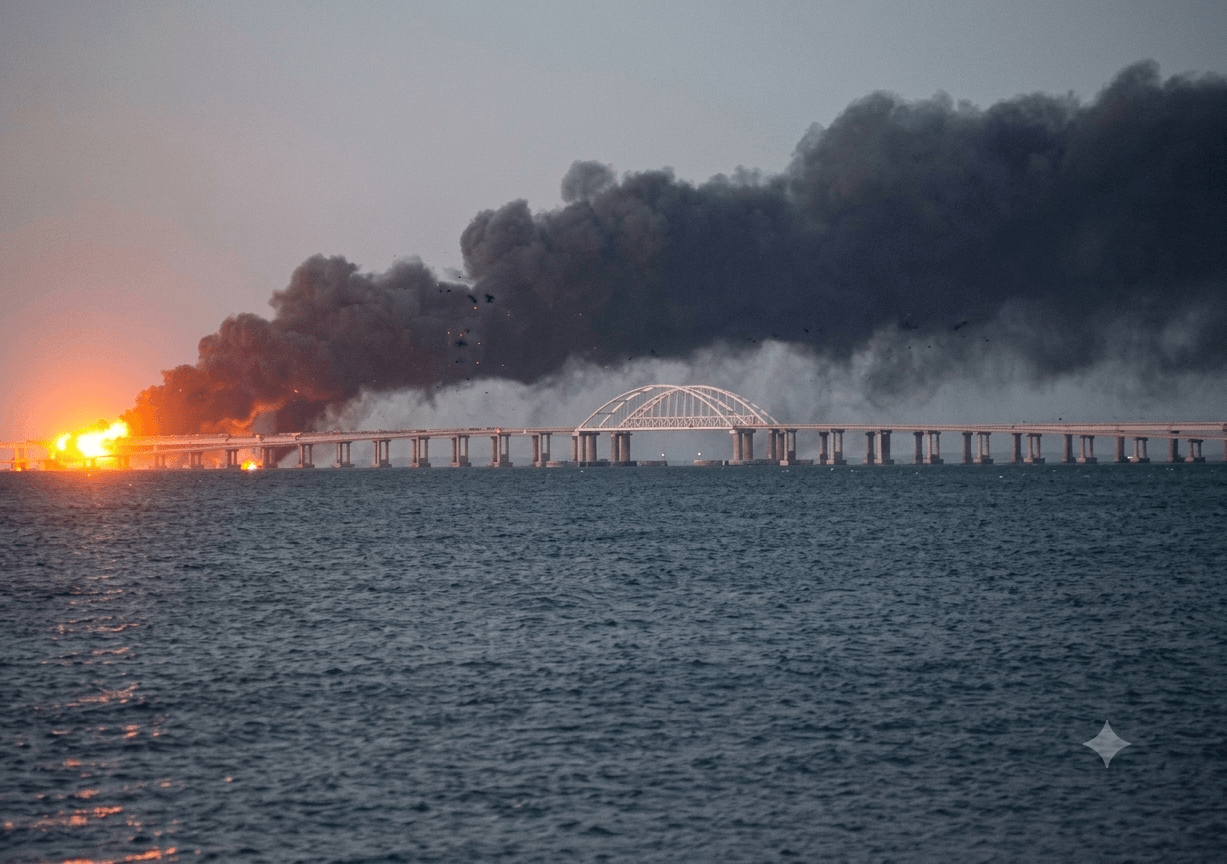


Crimea: Ukraine has dealt a major blow to one of Russia’s most strategically important infrastructure projects, claiming to have severely damaged the Crimean Bridge in an overnight operation involving drones and cruise missiles. The attack targeted the crossing over the Kerch Strait, which connects the Crimean peninsula with mainland Russia, and disrupted a vital transport route used by Moscow.
The strike comes just days before Russian President Vladimir Putin is scheduled to hold high-profile talks with US President Donald Trump and Chinese President Xi Jinping in Shenzhen, China. The war in Ukraine is expected to feature among the issues discussed during the meetings.
Ukrainian President Volodymyr Zelenskyy described the attack as an “unprecedented operation”, saying it had taken weeks of preparation and involved a systematic effort to weaken Russian defences around the bridge.
Images and videos circulated after the strike appeared to show a damaged section of the road bridge submerged in the sea.
“Russia strikes our infrastructure every day, including bridges,” Zelenskyy said. “We are … reminding Russia that war will always return to where it began.”
The attack is significant not only because of the physical damage but also because of the bridge’s symbolic importance to Moscow. Personally inaugurated by Putin in 2018, the crossing has long represented Russia’s efforts to consolidate its control over Crimea, which it annexed from Ukraine in 2014.
Ukraine describes seven-stage operation
According to Zelenskyy, the strike was the culmination of a seven-stage military and security operation designed to weaken Russian defensive capabilities around the strategically important crossing.
Ukrainian forces reportedly targeted several military installations and systems, including air defence equipment, radar facilities and electronic warfare capabilities. The gradual campaign was intended to reduce Russia’s ability to detect and intercept an attack on the bridge.
Ukraine’s Security Service (SBU) said its personnel had spent approximately a month systematically suppressing Russian air defence capabilities to create an opportunity for the operation.
The agency said the strike demonstrated that Russian military installations in occupied territories remained vulnerable despite Moscow’s efforts to protect them.
Several types of Ukrainian drones were deployed alongside domestically developed Flamingo and Neptune cruise missiles. Zelenskyy described the operation as a significant phase in Ukraine’s efforts to target Russian military infrastructure.
The damage appeared more extensive than that caused by previous Ukrainian attacks on the crossing. A major section of the road bridge reportedly collapsed, while the parallel railway section was also targeted. However, its supporting structure remained standing.
Sergei Aksyonov, the Russian-installed head of Crimea, said two people had been killed in the attack. Road traffic across the bridge was suspended following the incident, while railway services partially resumed after an initial disruption.
The suspension of road traffic immediately raised concerns about the movement of people and goods between Crimea and mainland Russia.
Why the Crimean Bridge is strategically important
The 19-kilometre Crimean Bridge is among the most prominent symbols of Russia’s annexation of Crimea in 2014. Moscow seized the Black Sea peninsula from Ukraine that year, a move that was widely rejected by the international community.
The bridge connects the Russian mainland to Crimea across the Kerch Strait and carries both road and railway traffic. Putin personally inaugurated the crossing in 2018, highlighting its political and strategic significance to the Kremlin.
Beyond its symbolic value, the bridge has served as an important logistical route for Russian military operations in southern Ukraine. It has been used to transport fuel, ammunition, military equipment and other supplies to the peninsula and areas where Russian forces are deployed.
The latest attack could therefore complicate Moscow’s logistical arrangements, particularly if repairs take an extended period.
Russia has increasingly relied on a land corridor running through occupied parts of southern and eastern Ukraine to transport supplies. Nevertheless, the Crimean Bridge remains an important alternative route, and its disruption could place additional pressure on existing transport networks.
Ukraine has repeatedly targeted the structure since Russia launched its full-scale invasion in February 2022.
In October 2022, a truck bomb exploded on the bridge, killing four people and forcing restrictions on traffic for several months. Another attack in July 2023 destroyed a section of the road bridge and killed a couple travelling in a car.
The latest operation appears to have caused more extensive structural damage, raising questions about the time and resources required to restore the crossing.
Kremlin promises reconstruction as damage assessment begins
Moscow has sought to downplay the long-term consequences of the attack, with the Kremlin promising to rebuild the damaged infrastructure.
Russian Presidential spokesperson Dmitry Peskov said Putin had been briefed about the incident. He also said the bridge would be reconstructed “even better than before”.
Russian Deputy Prime Minister Marat Khusnullin said a government commission had been convened to assess the damage and determine the work required to restore the crossing.
The commission is also expected to examine alternative arrangements for transporting cargo to Crimea while the bridge remains disrupted.
However, the scale of the reported destruction could make repairs difficult. Russia must also consider the possibility of further Ukrainian attacks on the crossing and surrounding infrastructure.
Finnish military analyst Emil Kastehelmi suggested that the damage could have lasting consequences for Moscow’s ability to use the bridge.
“The road bridge won’t be repaired during this war … Ukraine has achieved a victory with both concrete and symbolic implications,” he wrote on X.
His assessment points to the possibility that the disruption could extend beyond the immediate aftermath of the attack, although the actual repair timeline will depend on the findings of the Russian damage assessment.
Alternative supply routes face Ukrainian pressure
Russia has an alternative land corridor through territories it occupies in the Zaporizhzhia and Kherson regions. This route has become increasingly important for maintaining supplies to Crimea and supporting Russian military operations in the south.
However, the corridor is also vulnerable to Ukrainian attacks.
Ukraine has increasingly targeted transport infrastructure in and around northern Crimea, including routes near Chongar. Such strikes have complicated Russian efforts to maintain uninterrupted movement along alternative supply lines.
The disruption of the bridge could consequently place greater pressure on these routes, forcing Russian authorities to reassess how cargo and military supplies are transported to the peninsula.
The attack could also have implications for commercial shipping in the region. The bridge crosses a shipping channel used by vessels travelling into and out of the Sea of Azov, an important route for regional trade and grain exports.
The reported collapse of a major section, particularly its supporting arch, has raised concerns that debris could obstruct the channel. If that happens, the movement of larger commercial vessels could face additional complications.
The extent of any disruption to shipping will depend on the condition of the channel and the outcome of subsequent assessments.
Russian attacks damage bridges and infrastructure in Kyiv
The Ukrainian operation against the Crimean Bridge unfolded amid another round of Russian attacks on Ukrainian cities and infrastructure.
In Kyiv, Mayor Vitali Klitschko said Russian strikes had damaged the city’s Northern and Southern bridges, two important crossings over the Dnipro River.
Parts of the metro system were also affected, while disruptions to electricity, heating and water supplies were reported. The attacks prompted transport restrictions and forced residents to seek shelter as explosions were heard across the Ukrainian capital.
Russia also targeted energy infrastructure, adding to the pressure on essential services in the country.
The developments underline the continuing impact of the war on transport networks and civilian infrastructure on both sides.
For Ukraine, the attack on the Crimean Bridge represents an attempt to disrupt a key Russian supply route and demonstrate the vulnerability of infrastructure in occupied territory. For Moscow, the immediate challenge will be to assess the structural damage, restore transport connectivity and ensure supplies continue reaching Crimea.
The timing also gives the strike added political significance, coming ahead of Putin’s expected discussions with Trump and Xi in China. While the consequences for the battlefield remain to be seen, the attack has placed one of Russia’s most recognisable infrastructure projects back at the centre of the conflict.