







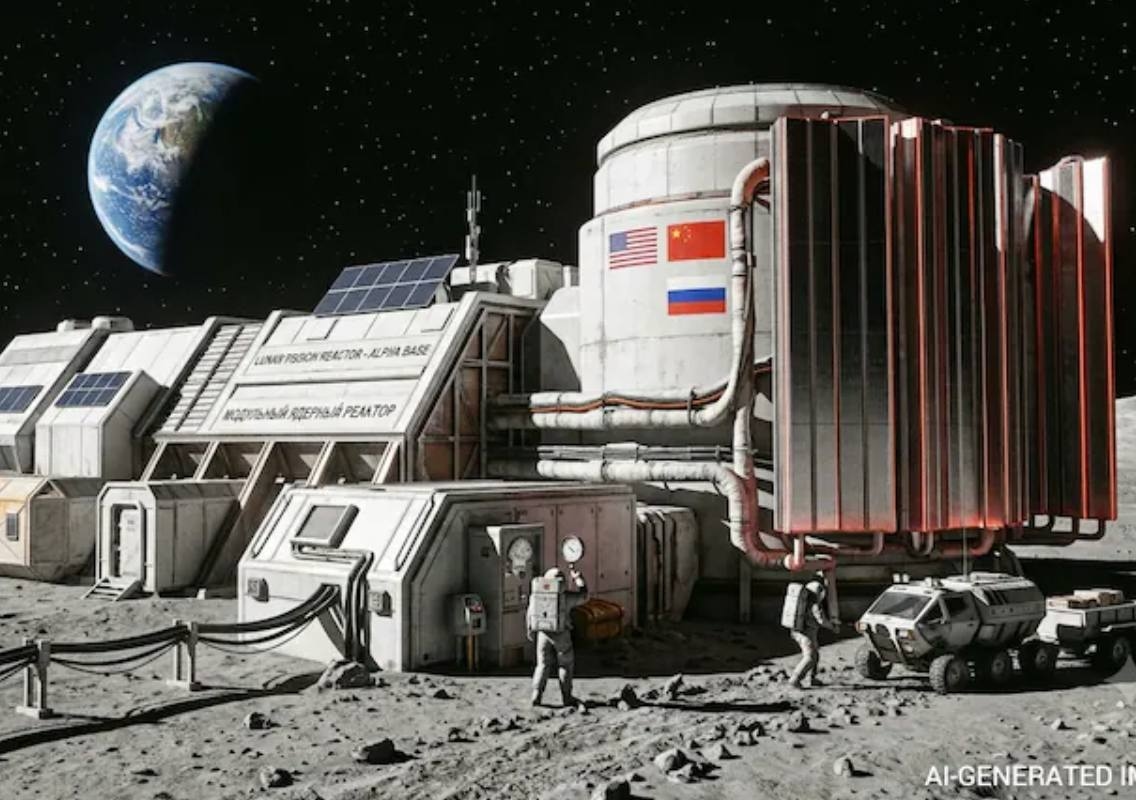


New Delhi: The United States, China and Russia are accelerating plans to develop nuclear power systems for the Moon as they prepare for a new phase of lunar exploration that could eventually include permanent bases.
Nuclear reactors could provide a dependable source of electricity for lunar settlements, where solar power faces a major limitation: the Moon’s night lasts roughly two weeks. The US is reportedly targeting 2030 for the deployment of a lunar reactor, while Russia and China are working on a joint project that could be operational in the mid-2030s.
According to a report by The New York Times, NASA has asked companies to develop proposals for a nuclear reactor capable of travelling to the Moon, operating near the lunar south pole and functioning with little or no maintenance. The US agency is targeting December 2030 for the launch of the system.
Russia is also developing plans for a lunar reactor known as Selena. The project is reportedly being pursued in cooperation with China and is intended to provide electricity for future Chinese-led lunar facilities.
The plans underline how nuclear energy is becoming an important part of the competition to establish a sustained human and robotic presence on the Moon.
Why do countries want nuclear reactors on the Moon?
A permanent lunar base would require a continuous and reliable source of electricity.
Solar energy is an obvious option because sunlight is abundant on the Moon. However, lunar nights last more than 14 Earth days in many locations. During this period, solar panels cannot generate electricity, creating a major challenge for equipment and habitats that need to operate continuously.
Batteries can store energy generated during daylight, while radioisotope systems can provide heat and limited power for certain spacecraft. But a large lunar settlement would eventually require substantially more electricity.
Nuclear fission reactors could operate independently of sunlight and provide power for long periods. Such systems could support habitats, scientific instruments, communications equipment, rovers and facilities involved in processing lunar resources.
The technology could therefore become important if space agencies move from short-duration missions towards permanent infrastructure.
US targets 2030 for lunar reactor
NASA’s proposed lunar power programme is aimed at developing a compact fission reactor capable of operating in the harsh lunar environment.
According to the New York Times report, NASA’s Lunar Reactor 1 is expected to produce around 20 kilowatts of electricity and operate for approximately five years without human intervention.
The reactor would need to survive the journey from Earth, operate reliably after landing and function in an environment with extreme temperatures and no atmosphere.
The lunar south pole is particularly important to NASA because the region contains permanently shadowed areas believed to contain water ice, while some nearby locations receive sunlight for relatively long periods.
A dependable power source could allow future missions to remain active even when solar generation is interrupted.
Russia and China plan a different lunar reactor
Russia is also developing a nuclear power system for future lunar infrastructure.
The project, reportedly called Selena, is being developed as part of closer space cooperation between Russia and China. The reactor is reportedly designed to generate up to 10 kilowatts and operate autonomously for about 10 years.
The proposed system could eventually provide electricity to lunar stations associated with China’s plans for sustained exploration.
China and Russia have previously announced cooperation on the International Lunar Research Station, a long-term programme intended to develop research infrastructure on the Moon.
The reported reactor plans suggest that nuclear energy could become a central component of that infrastructure if the projects proceed as planned.
Solar power will still have a role
The development of lunar reactors does not mean solar energy will disappear from future missions.
In the initial stages of lunar exploration, solar panels are expected to remain a major source of electricity. Spacecraft can also use radioisotope systems to generate heat and power in situations where sunlight is unavailable.
However, the energy requirements of a permanent base would be considerably greater than those of an individual lander or rover.
A larger settlement could require electricity for life-support systems, laboratories, communications, navigation, mining and resource-processing equipment.
Nuclear reactors could therefore complement solar systems rather than completely replace them.
Nuclear reactors create new safety challenges
Putting a nuclear reactor on the Moon also presents significant risks.
One of the biggest concerns is the possibility of an accident during launch. A rocket carrying a reactor could fail before reaching space, raising questions about the potential release of radioactive material.
The US and Russia are reportedly considering sending their reactors to the Moon in an inactive state. Keeping the systems inactive during launch and transportation could reduce some risks, although it would not eliminate them completely.
Once on the Moon, another challenge would be protecting astronauts and equipment from radiation.
On Earth, nuclear facilities rely on substantial shielding and containment infrastructure. Constructing equivalent protective structures on the Moon would be difficult because of the cost and logistical challenges involved in transporting materials or building them from lunar resources.
Future lunar bases may therefore need to establish safety zones around nuclear installations.
Who owns the Moon?
The nuclear race also raises complicated questions about lunar governance.
The 1967 Outer Space Treaty establishes that the Moon and other celestial bodies cannot be claimed as sovereign territory by individual countries. It also establishes principles concerning the peaceful use and exploration of outer space.
However, future lunar settlements could create difficult questions about access and safety.
If a country builds a reactor and establishes a lunar base, it may need to restrict access to the immediate area around the installation for safety reasons. Such restrictions could become controversial if they effectively prevent other countries from operating in nearby areas.
Another unresolved issue concerns lunar resources. The Outer Space Treaty prohibits national appropriation of celestial bodies, but countries continue to debate how this principle applies to resources extracted from the Moon.
The development of permanent infrastructure could make these legal questions increasingly important.
A new phase of lunar competition
The US, China and Russia have yet to demonstrate that their proposed lunar reactors can be successfully deployed and operated on the Moon.
The timelines are also subject to technical, financial and safety considerations and could change as development progresses.
Nevertheless, the competing programmes illustrate how lunar exploration is moving beyond individual missions towards the possibility of long-term infrastructure.
For the US, China and Russia, reliable power could be one of the key requirements for establishing a sustained presence on the Moon. Nuclear reactors offer a potential solution to the limitations of solar power, but they also introduce a new set of engineering, environmental, safety and legal challenges.
As countries prepare for future lunar bases, the question may no longer be simply who can reach the Moon first, but who can build and safely operate the infrastructure needed to stay there.