







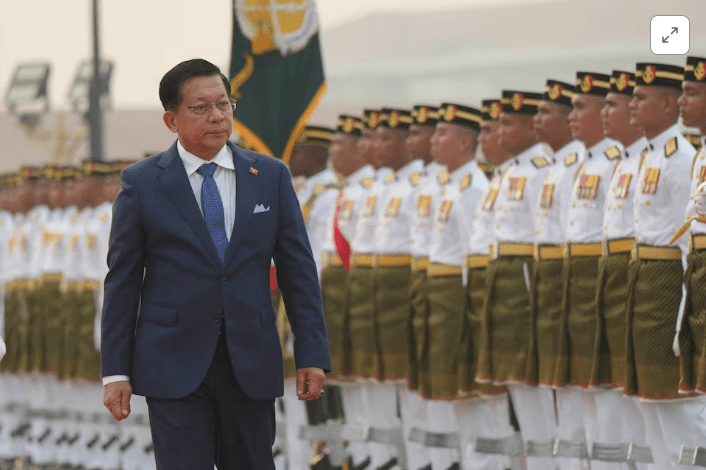


Washington: The Trump administration has begun direct talks with Myanmar’s military-installed government, marking a significant shift from Washington’s efforts to isolate the country’s generals following the 2021 military coup, according to US officials and others familiar with the outreach.
The talks have focused initially on efforts to shut down scam centres targeting Americans and secure the release of detained US businessman Adam Castillo. However, the engagement could expand to areas such as Myanmar’s deposits of heavy rare-earth minerals, which are important for electric vehicles, wind turbines and other technologies.
US Assistant Secretary of State for Intelligence and Research Michael Vance has played a leading role in the outreach. He met Myanmar’s military leader-turned-president Min Aung Hlaing in Naypyitaw on September 15 and 16, in what was described as the highest-level US contact with Myanmar’s military government since the coup.
The development comes despite continuing US sanctions against Min Aung Hlaing and international criticism of Myanmar’s military over its treatment of civilians and political opponents.
Michael Vance leads US outreach
Vance, who was confirmed as the State Department’s top intelligence official in August, took part in the meeting with Min Aung Hlaing as Washington sought Castillo’s release.
Four people familiar with the discussions said the meeting, while initially focused on the detained American, also created an opening for wider engagement between Washington and Myanmar’s military-installed government.
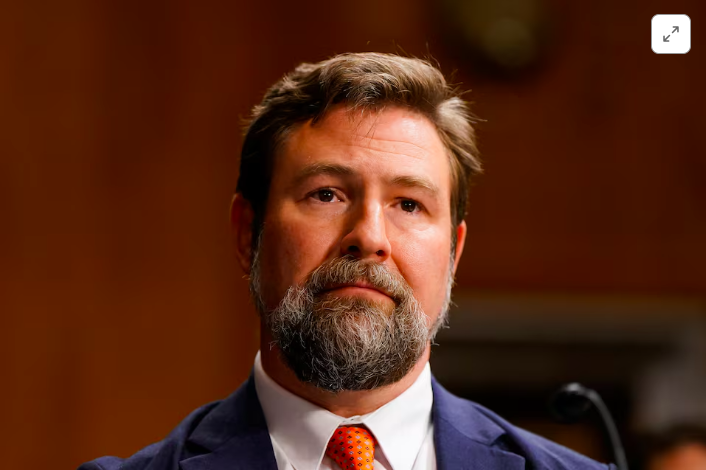
The role played by Vance in shaping Myanmar policy had not previously been publicly reported, according to Reuters.
Current and former US officials told Reuters that Vance has also met representatives from different sides of Myanmar’s conflict, including democratic opposition figures and ethnic armed groups fighting the military.
His involvement is notable because intelligence officials typically maintain a degree of distance from policy-making to protect the independence of intelligence assessments.
Richard Betts, an adjunct senior fellow at the Council on Foreign Relations who has consulted for US intelligence agencies, said allowing policy considerations to influence intelligence assessments could undermine confidence in the analysis.
State Department spokesperson Tommy Pigott declined to detail Vance’s role but said the administration operates as a team under President Donald Trump.
Detained American helped open diplomatic channel
The US engagement was partly prompted by the detention of American businessman Adam Castillo.
Castillo, a former head of the American Chamber of Commerce in Myanmar, was detained at Yangon airport on June 11 by Myanmar authorities.
People supporting Castillo described the charges against him as unfounded, while the US government has not publicly determined whether his detention was wrongful.
According to people familiar with the matter, officials from the White House, National Security Council and State Department held back-channel negotiations with Myanmar authorities to secure his release.
One person said Myanmar’s condition for Castillo’s release was an official engagement with the US government at an appropriate level.
Castillo was subsequently released and declined to comment beyond crediting Trump for his freedom.
The September meeting between Vance and Min Aung Hlaing therefore served both as an effort to address an individual detention case and as a potential opening for broader US-Myanmar discussions.
US seeks action against scam centres
A major focus of the new engagement is Myanmar’s extensive network of scam centres.
US officials are seeking cooperation from Myanmar authorities to shut down operations involved in romance scams and other forms of fraud that have targeted Americans and caused billions of dollars in losses.
Two people familiar with the matter said the FBI has established direct contact with Myanmar authorities over cyber scams.
The issue presents a practical area of cooperation for Washington because many of the criminal operations are based in territories controlled by militias or ethnic armed groups rather than directly by the central military government.
Researchers have also said some of the proceeds from scam operations flow to the military, raising questions over how effectively authorities can or will act against the networks.
For Washington, however, cooperation on cyber-enabled fraud provides a concrete issue on which engagement with Myanmar’s authorities could produce results.
The talks therefore represent a shift towards pursuing specific US interests through direct contact rather than relying primarily on diplomatic isolation and sanctions.
Rare-earth minerals could broaden engagement
The discussions have also touched on Myanmar’s deposits of heavy rare-earth minerals.
These minerals are important components in several advanced technologies, including electric vehicles and wind turbines. The United States has been seeking to diversify critical-mineral supply chains and reduce dependence on China.
Myanmar’s deposits could potentially become relevant to that strategy.
There are, however, significant obstacles.
Much of Myanmar’s heavy rare-earth production is located in territory controlled by ethnic armed organisations that are fighting the military government. That means access to the resources cannot necessarily be secured simply through an agreement with Min Aung Hlaing’s administration.
China is currently the main importer of Myanmar’s rare-earth resources and could view an expanded US role in the sector as a challenge to its interests.
Even so, people familiar with the discussions said Myanmar’s mineral resources remain a recurring subject in US policy discussions because of Washington’s broader efforts to diversify critical supply chains.
Min Aung Hlaing remains under US sanctions
The new diplomatic contact does not mean that Washington has lifted its sanctions against Myanmar’s military leadership.
Min Aung Hlaing remains under US sanctions over human rights abuses, including the military campaign against the Rohingya population in 2016 and 2017.
The United States has described the mass killings and expulsions of Rohingya Muslims during that period as genocide.
Myanmar’s military has also continued to face accusations of attacks against civilians during the country’s ongoing conflict.
Less than two weeks after Vance’s visit to Naypyitaw, the Myanmar military carried out an airstrike on a crowded marketplace in Rakhine state that killed more than 50 people and injured scores of others, according to UN human rights officials.
The timing has highlighted the tension between Washington’s renewed engagement and the continuing allegations of military abuses in Myanmar.
US says engagement does not end criticism
The State Department said its engagement with Myanmar’s military-installed government does not mean Washington has abandoned contact with other groups in the country.
The department said the United States continues to engage with different groups on issues affecting American interests while also raising the need for an end to violence and the release of political prisoners.
Pigott defended the approach by saying problems could not be resolved by ignoring them.
The State Department also said the United States continues to provide assistance to areas outside military control, although it did not provide details about the nature or scale of that assistance.
This suggests Washington is attempting to maintain relationships with Myanmar’s opposition and ethnic groups while simultaneously establishing direct channels with the military government.
Policy shifts from sanctions towards engagement
The new approach represents a departure from the policy pursued after the February 2021 coup.
The administration of former US President Joe Biden froze Myanmar’s assets held at the Federal Reserve Bank of New York and imposed sanctions on senior military officers and businesses linked to the military.
In 2022, the US Congress also authorised non-lethal assistance for opposition groups. The support included early-warning systems intended to help civilians detect airstrikes and programmes designed to encourage military officers to defect.
According to current and former officials and State Department correspondence reviewed by Reuters, most of those programmes were cut during the Trump administration’s foreign-aid overhaul last year.
The shift has drawn criticism from some members of Congress.
Representative Gregory Meeks, the top Democrat on the House Foreign Affairs Committee, said the engagement with Min Aung Hlaing was contrary to US values and interests.
He argued that engaging Myanmar’s military government while failing to fully implement sanctions and democracy-related funding requirements could provide the regime with greater international legitimacy.
Myanmar seeks international legitimacy
Min Aung Hlaing has sought greater international recognition for Myanmar’s military-installed administration as it attempts to present itself as a nominally civilian government.
The military seized power in 2021 after alleging electoral fraud, a justification rejected by opponents. Since then, the country has been engulfed in a conflict involving the military, democratic forces and numerous ethnic armed organisations.
The military government has labelled its opponents terrorists while attempting to strengthen its international diplomatic relationships.
Recent contacts with foreign governments, including the United States, therefore have significance for the military leadership beyond individual agreements or security cooperation.
For Washington, the talks provide an avenue for addressing issues such as American detainees and online fraud. For Myanmar’s military government, direct contact with a major power could potentially contribute to its efforts to gain greater international legitimacy.
Lobbying efforts add another dimension
Myanmar’s government has also expanded efforts to influence policy in Washington.
According to Foreign Agents Registration Act filings, longtime Trump adviser Roger Stone began consulting for DCI Group on behalf of Myanmar’s Ministry of Information in April.
Stone was convicted in 2019 of obstructing a congressional investigation into Russian interference in the 2016 US election and was later pardoned by Trump.
A DCI newsletter circulated in June warned that Washington could risk losing access to Myanmar’s critical minerals if it did not engage with the country.
The lobbying effort reflects the growing importance of Myanmar’s natural resources in discussions about US-China competition and critical-mineral supply chains.
A broader US-Myanmar policy shift
The September meeting between Vance and Min Aung Hlaing followed an earlier meeting between US and Myanmar officials in Tokyo in June.
One person familiar with that meeting said representatives from the Treasury Department, which oversees sanctions, as well as the Department of Homeland Security and Pentagon were involved.
Vance’s participation in discussions involving Myanmar’s military government, opposition figures and ethnic armed groups suggests Washington is attempting to engage with multiple sides of the country’s complex conflict.
The immediate priorities appear to be practical matters such as securing American citizens’ interests and combating cybercrime. But the discussions could eventually extend to economic issues, particularly critical minerals.
For Myanmar, the outreach offers a potential route to greater international engagement despite continuing sanctions and criticism over military actions.
For the United States, it reflects a more transactional approach in which specific security, economic and strategic interests are being pursued alongside, rather than solely through, democracy and human-rights policy.