







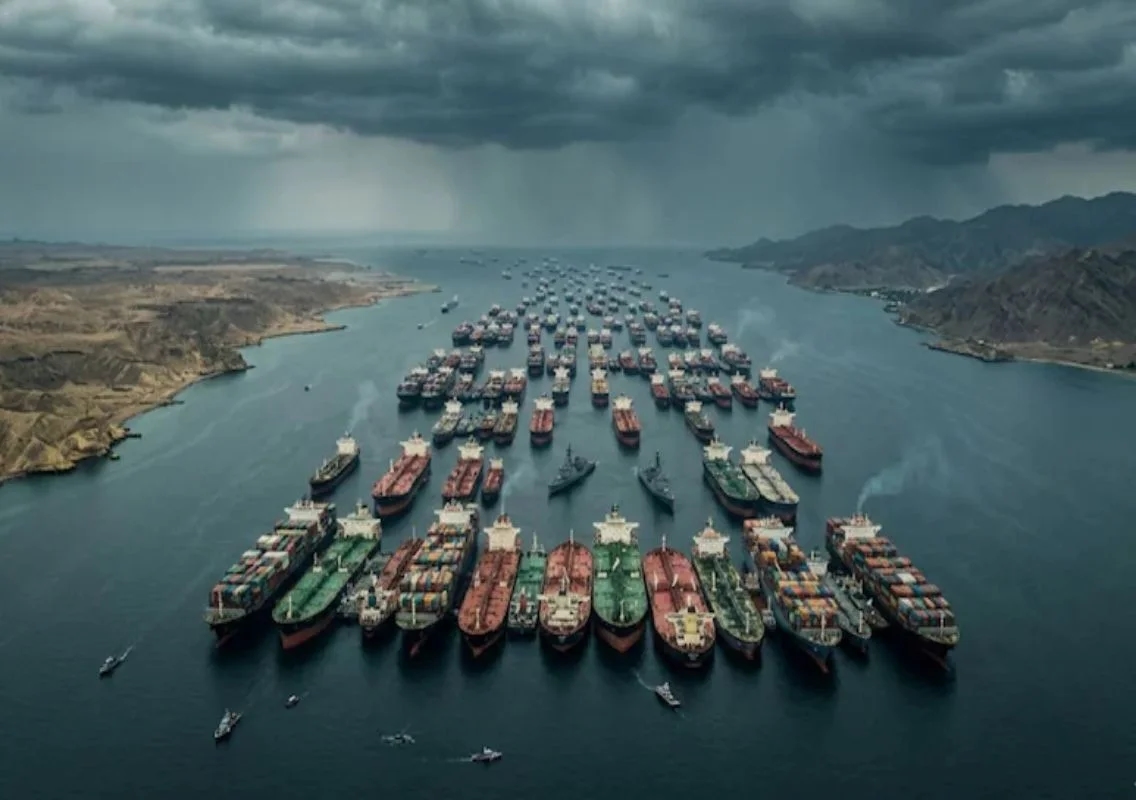


Tehran: The ongoing tensions in West Asia have brought renewed global focus on the legal status of key maritime routes, particularly the Strait of Hormuz and the Suez Canal. While both are critical for international trade and energy transport, international law treats them very differently when it comes to charging transit fees.
Iran’s recent proposal to impose tolls on ships passing through the Strait of Hormuz has triggered widespread concern, especially among oil-importing nations. However, under established maritime law, such a move is widely viewed as illegal. In contrast, Egypt’s long-standing practice of charging transit fees for ships using the Suez Canal is considered lawful.
Why the Suez Canal can charge fees
The Suez Canal, located in Egypt, is a man-made waterway connecting the Mediterranean Sea to the Red Sea. Built and maintained through significant investment and engineering effort, the canal is treated as national infrastructure under international law.
As a result, Egypt has the legal right to impose transit fees on vessels using the canal. These charges are meant to cover the costs of construction, maintenance, and operational services. The system is widely accepted and forms a major source of revenue for Egypt.
A similar principle applies to the Panama Canal, another artificial waterway where ships are required to pay tolls for passage.
Why Hormuz tolls are not allowed
In contrast, the Strait of Hormuz is a natural waterway situated between Iran and Oman. It serves as a crucial link between the Persian Gulf and the Indian Ocean, handling nearly 20 per cent of the world’s oil shipments.
Under the United Nations Convention on the Law of the Sea (UNCLOS), such natural straits are governed by the principle of “transit passage.” This ensures that all vessels have the right to pass through without unnecessary hindrance.
Importantly, UNCLOS prohibits countries bordering such straits from charging fees simply for allowing ships to pass. This means Iran cannot legally impose a general transit toll on vessels using the Strait of Hormuz.
Limited charges allowed under international law
While general transit fees are not permitted, international law does allow coastal states to impose certain limited charges. These include fees for specific services such as pilotage, tug assistance, or port-related facilities.
However, these charges must be service-based and non-discriminatory, meaning they cannot target specific countries or be used as a tool for political leverage.
Iran’s proposal and global concerns
Iran’s reported plan to introduce transit fees as part of a broader geopolitical strategy has raised alarms across the international community. The proposal includes charging ships based on cargo type and volume, with some reports suggesting a fee of $1 per barrel of oil.
Such a move is seen as a violation of established maritime norms and could set a dangerous precedent if implemented. Countries dependent on energy imports, including India, have expressed concern over the potential disruption to global supply chains.
Gulf nations have also opposed the idea, emphasising that the Strait of Hormuz must remain open and accessible to all. The United States has similarly insisted that free navigation through the strait be a key component of any future peace agreement in the region.
Strategic and economic implications
The Strait of Hormuz is one of the most strategically significant chokepoints in the world. Any restriction or additional cost imposed on shipping could lead to a sharp increase in global oil prices, impacting economies worldwide.
Unlike artificial canals, natural straits are considered shared international resources. Allowing unilateral control or monetisation by a single country could undermine the principles of free trade and open navigation.
Conclusion
The distinction between the Suez Canal and the Strait of Hormuz lies in their nature and legal classification. While the former is a man-made waterway where transit fees are legally justified, the latter is a natural strait governed by international law that guarantees free passage.
Iran’s attempt to levy tolls on ships using the Strait of Hormuz challenges these established norms and has sparked global debate. As geopolitical tensions continue, the issue underscores the importance of adhering to international maritime laws to ensure stability and uninterrupted global trade.