







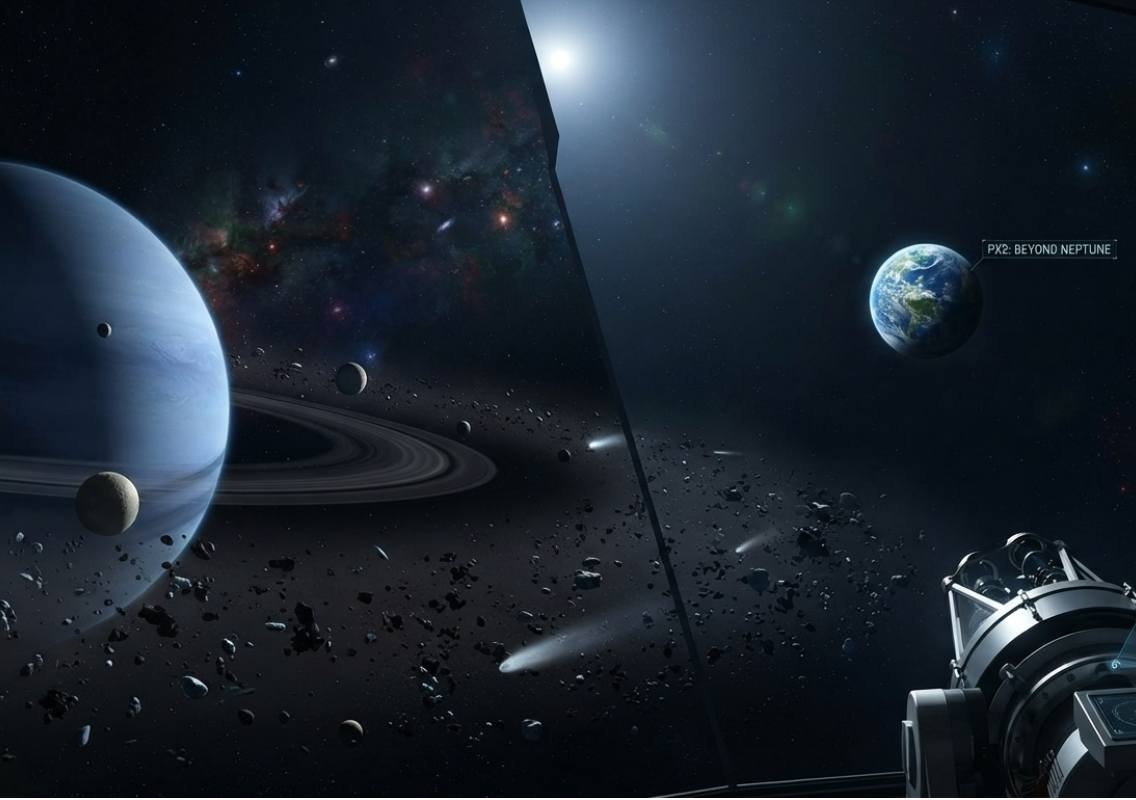


Space: Astronomers have proposed the possibility of an undiscovered planet beyond Neptune that could help explain the unusual movements of icy objects in the distant reaches of the Solar System. The hypothetical world, dubbed Planet X2 (PX2), is believed to have between 1.5 and two times the mass of Earth and could orbit hundreds of times farther from the Sun than Earth.
The proposal is based on a study published in the journal Monthly Notices of the Royal Astronomical Society, which uses computer simulations to examine how the gravity of a distant planet could influence the orbital patterns of objects beyond Neptune.
The research offers a new explanation for some of the unusual orbital features observed among distant trans-Neptunian objects (TNOs), which are bodies located beyond Neptune’s orbit. However, PX2 remains hypothetical, and astronomers have not yet confirmed its existence. The Royal Astronomical Society
What is Planet X2 and how big could it be?
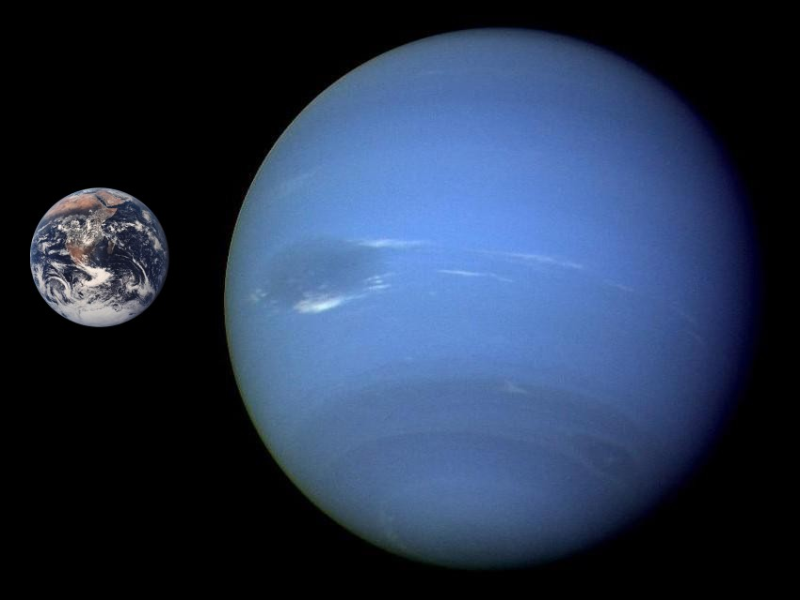
Planet X2, or PX2, is a proposed distant planet that researchers believe could have a mass roughly 1.5 to two times that of Earth.
Unlike planets located closer to the Sun, PX2 would occupy an extremely distant region of the Solar System. According to the study, the proposed planet could orbit at hundreds of astronomical units from the Sun, far beyond Neptune and the region occupied by most familiar planetary bodies.
An astronomical unit (AU) is the average distance between Earth and the Sun, approximately 150 million kilometres. The researchers’ model suggests that PX2 could have an elliptical orbit with a semi-major axis of approximately 350 to 500 AU, while its closest approach to the Sun could remain at around 200 AU or more.
If such a planet exists, it would be extremely distant and potentially difficult to detect using conventional observations.
The proposed planet is not the same as the widely discussed Planet Nine hypothesis, which suggests that a substantially more massive planet, potentially around 10 times Earth’s mass, could be responsible for some of the orbital irregularities observed among distant objects.
Unusual movements of icy objects raise questions
Astronomers began exploring the possibility of an additional planet after observing unusual orbital patterns among distant icy objects beyond Neptune.
These objects, known as trans-Neptunian objects, occupy the outer regions of the Solar System. Many are located in the Kuiper Belt, while some travel much farther away, following elongated or highly tilted orbits.
Over the past two decades, researchers have identified distant objects whose movements appear difficult to explain entirely through the gravitational influence of the eight known planets.
One of the most intriguing examples is Sedna, a distant Solar System object with an exceptionally elongated orbit that takes it far beyond the region occupied by the known planets.
Scientists have been investigating whether the gravitational influence of an undiscovered planet could help explain why some of these objects follow such unusual trajectories.
The proposed PX2 model offers a possible explanation for several of these orbital patterns, suggesting that an additional planet could influence the movements of distant icy bodies and alter their orbital inclinations and trajectories. The Royal Astronomical Society
Computer simulations trace 4.5 billion years of Solar System evolution
To investigate the possibility of PX2, researchers conducted computer simulations spanning approximately 4.5 billion years of the Solar System’s history.
The simulations examined how the Solar System evolved from its early formation through the migration of the giant planets into their present positions. Researchers compared scenarios involving the four known giant planets with models incorporating additional distant planetary bodies.
The study explored how the gravitational influence of a hypothetical planet could affect objects in the outer Solar System over billions of years.
According to the researchers, PX2 could help reproduce several of the unusual orbital patterns observed among distant icy objects. Its gravitational influence could potentially alter the trajectories of these bodies, including separating some from Neptune’s gravitational influence and producing unexpectedly tilted orbits.
However, the researchers acknowledged that their model does not explain every observed feature perfectly, and further investigation is needed to establish whether PX2 is a realistic explanation.
Researchers say discovery could transform Solar System understanding
Patryk Sofia Lykawka, the study’s lead author and an adjunct associate professor at the University of Southern Queensland, said discovering an additional planet after decades of studying the Solar System would be a remarkable achievement.
The proposed model builds on the longstanding search for hidden planets in the outer Solar System, including the Planet X concept and the more recent Planet Nine hypothesis.
The search for an undiscovered planet beyond Neptune has historically influenced astronomy. Percival Lowell’s search for Planet X contributed to the circumstances surrounding Pluto’s discovery in 1930, although later research established that Pluto was too small to explain the planetary movements that had originally motivated the search.
The new PX2 proposal is based on a different set of orbital observations and computer simulations, offering another possible explanation for the dynamics of the distant Solar System.
Vera C. Rubin Observatory could help test the theory
Researchers hope that the Vera C. Rubin Observatory in Chile will play a significant role in investigating the possibility of PX2.
The observatory’s extensive sky surveys are expected to identify and track numerous distant objects, helping astronomers study the orbital patterns of bodies beyond Neptune in greater detail.
By discovering more trans-Neptunian objects and monitoring their movements, researchers could gather additional evidence to determine whether the gravitational influence of a hidden planet is necessary to explain their trajectories.
The observatory’s observations could help test the predictions made by the PX2 model and potentially narrow down the locations where such a planet might be found.
Although the existence of PX2 remains unconfirmed, the proposal highlights how unusual movements of distant objects can offer clues about the structure and evolution of the Solar System.
If astronomers eventually discover the proposed planet, it could significantly reshape our understanding of the Solar System’s outermost regions and the forces that have influenced its evolution over billions of years.