







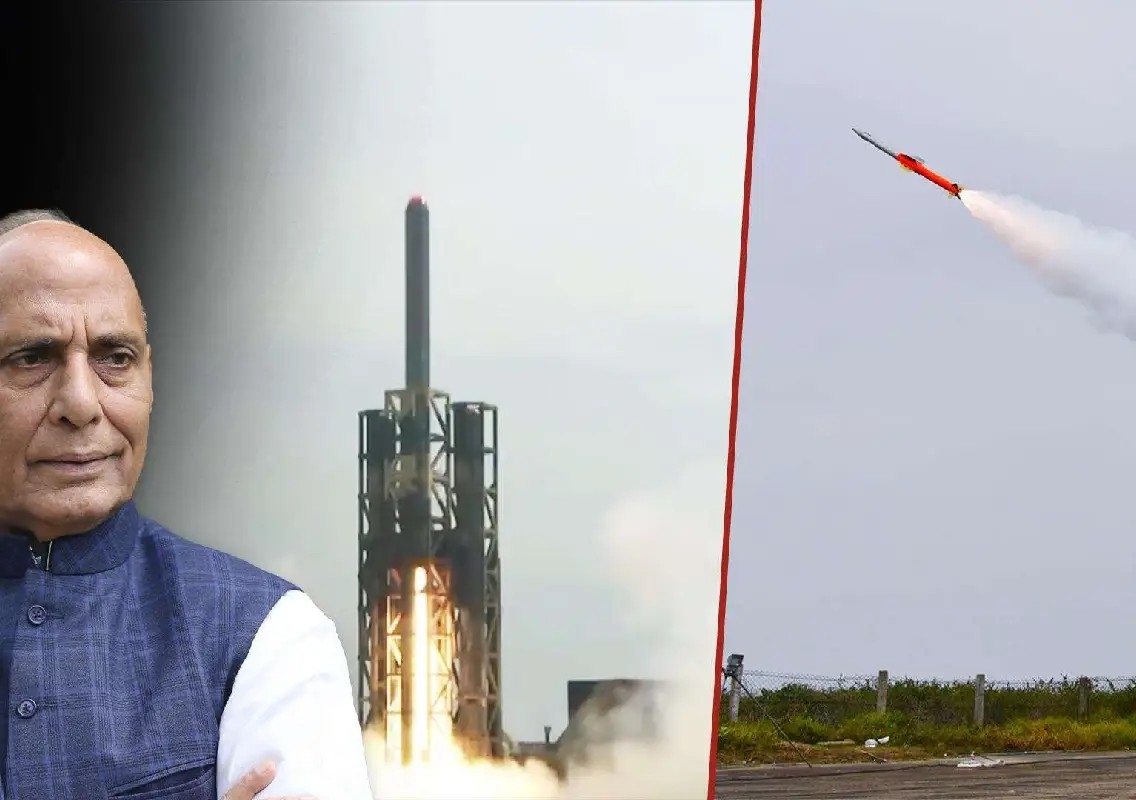


New Delhi: India has taken a significant step towards strengthening its domestic defence manufacturing capabilities by allowing private Indian companies to access technologies developed by the Defence Research and Development Organisation (DRDO) for conventional missile systems.
The decision, approved by Defence Minister Rajnath Singh, is aimed at expanding domestic production, speeding up the transition of defence technologies from laboratories to factories and reducing India’s dependence on imported weapons.
The move also marks a major shift in a sector that has traditionally been dominated by government-owned defence companies and institutions.
Private companies to get access to missile technologies
The Ministry of Defence said DRDO-developed technologies for all conventional missile systems would be transferred to Indian defence companies for domestic production.
Companies will have to meet technical qualifications, certification requirements and other regulatory conditions before they can obtain production rights.
The government said the initiative would strengthen India’s defence industrial base while creating greater opportunities for micro, small and medium enterprises (MSMEs) and technology partners to participate in defence supply chains.
The policy covers a wide range of missile technologies, including surface-to-air, air-to-air, anti-radiation and anti-tank systems. It can also extend to more sophisticated systems such as land-attack cruise missiles.
Breaking the traditional government monopoly
India has historically depended heavily on state-owned companies to manufacture weapons developed by DRDO. Bharat Dynamics has been a major player in the country’s missile production.
The latest decision could allow private companies to move beyond supplying individual components and become prime integrators responsible for manufacturing complete missile systems.
According to defence analyst Aditya Ramanathan of the Takshashila Institution, this represents a major change for India’s defence industry.
Private companies have already been involved in producing missile components for years. The new policy, however, could allow them to move further up the value chain and take on larger responsibilities in the development and production process.
Push for self-reliance in defence
The decision fits into the Narendra Modi government’s broader Atmanirbhar Bharat, or self-reliant India, initiative.
Although India has developed and manufactured a large number of its own missile systems, it continues to import certain weapons and defence technologies, particularly from countries such as Russia and Israel.
Expanding the role of domestic private companies is intended to reduce this dependence while building a stronger industrial ecosystem within the country.
The government also wants foreign defence companies to manufacture more equipment in India, but greater participation from domestic firms is considered essential to developing long-term manufacturing capacity.
Changing security environment adds urgency
India’s efforts to expand missile production come amid a challenging regional security environment.
The country shares major borders with China and Pakistan, while recent conflicts and international wars have highlighted the importance of maintaining adequate stocks of precision weapons and other military equipment.
India’s defence budget has also increased substantially over the past decade. The current financial year’s allocation is significantly higher than the previous year’s, reflecting the government’s emphasis on strengthening military preparedness.
The experience of recent wars, including the Russia-Ukraine conflict and developments involving precision strikes in other regions, has also influenced defence planning.
Analysts have pointed out that modern warfare can rapidly consume missile inventories. Maintaining sufficiently large stockpiles, therefore, requires the ability to manufacture advanced weapons quickly and continuously.
Private sector could help build missile stockpiles
India is also working towards creating a tri-services conventional missile force. Such a force would require substantial quantities of missiles to maintain operational readiness over an extended period.
Greater private-sector participation could help address this requirement by increasing production capacity and introducing competition among manufacturers.
The government’s approach is not simply about increasing the number of companies producing defence equipment. It is also intended to create a broader ecosystem involving large defence companies, MSMEs, technology firms and startups.
Such an ecosystem could improve supply-chain resilience and provide the military with additional domestic sources for critical equipment.
India’s private defence industry is expanding
The decision comes as India’s private defence industry has already been expanding into several advanced areas.
In June, the government announced plans to spend more than $2 billion on military drones from domestic manufacturers. More than 600 companies are reportedly involved in India’s drone sector, ranging from major industrial groups to technology startups.
Companies including Tata Advanced Systems, Larsen & Toubro and Adani have developed significant capabilities in the defence sector.
The growing involvement of private companies suggests that India’s defence industry is gradually moving away from its traditional government-dominated structure.
Security concerns will remain important
Opening sensitive missile technologies to private companies will also require stringent safeguards.
Missile systems involve highly sensitive technologies, and their transfer to industry will need to be accompanied by strict security, certification and regulatory controls.
The government has indicated that companies will have to meet technical and regulatory requirements before being allowed to manufacture these systems.
DRDO will continue to work with industry to facilitate the transfer and absorption of advanced defence technologies.
A major shift in India’s military-industrial strategy
The decision to share DRDO missile technologies with the private sector signals a broader change in India’s approach to defence production.
By allowing more companies to manufacture sophisticated weapons, the government hopes to expand production capacity, shorten the time between technological development and military deployment, strengthen domestic supply chains and reduce reliance on foreign suppliers.
For India, the challenge will be to ensure that increased private-sector participation translates into reliable, high-volume production while maintaining strict standards for quality, security and military effectiveness.